Warum besuchen

Für wen es perfekt ist

Prioritize the Catacombes de Paris if you are drawn to urban history, archaeology, and the darker layers of Paris beyond the postcard landmarks.

The 45-minute route through former quarries about 20 m underground is sober, memorable, and specific to the city; booking is required, and the experience is strongest when approached as a historical ossuary rather than entertainment.

Wer es lieber auslässt

Skip it, or keep it low on your list, if you are claustrophobic, uncomfortable around human remains, or have limited mobility: the route is cool, damp, narrow in places, with 131 steps down and 112 back up. Practical verdict: go if the subject genuinely interests you; do not force it into a first Paris trip just because it is famous.

Was Sie vorher wissen sollten

Editorial note: Treat the Catacombes de Paris as a focused historical visit, not a scare attraction. The strongest part is the contrast between the calm, controlled route and the scale of the ossuary; visitors who like urban history, archaeology, and darker Paris stories tend to get the most from it.

Good to knowThe physical side matters. The route is cool, damp, narrow in places, and stair-heavy, with 131 steps down and 112 back up; anyone uncomfortable with enclosed underground spaces, or expecting a theatrical horror-style experience, may leave underwhelmed or stressed rather than impressed.

🎫 Tickets, Touren & Rabatte

Which ticket to choose

For most visitors, the standard timed-entry ticket is the right choice. It includes the audio guide, gives access to the full 1.5 km one-way route, and is enough if you are comfortable visiting independently.

Pay more only when it solves a real problem: an official slot is unavailable, you need a guided explanation in English, or you want a packaged ticket from an authorised reseller. “Fast-track” here mainly means entering at your booked time, not a luxury VIP experience.

  • Standard timed ticket: best value for independent visitors.
  • Reduced or child ticket: best for eligible students, young visitors, and families.
  • Authorised reseller ticket: useful when official availability is tight.
  • Guided tour: worth it if you want context, not just access.
ImportantThe common first-time mistake is buying from a random “Catacombs ticket” website and assuming it is official. Stick to the official ticket channel or authorised sellers such as GetYourGuide, Tiqets, Headout, Klook, Paris City Vision, and other listed partners.

When to go

The Catacombs are open Tuesday to Sunday, 9:45–20:30, with last admission at 19:30; they are closed on Monday. The route itself takes about 45 minutes, but choose your time slot carefully because entry is limited and this is not a good place for a spontaneous walk-up plan.

There is no sunset advantage underground: light, temperature, and photo conditions stay the same. For a calmer visit, choose the first morning slots or later afternoon slots; midday and weekends feel more compressed, especially around the narrow passages and ossuary sections.

Recommendation: solo visitors should take an early or late slot for the quietest rhythm; families should avoid the final entry and leave enough energy for the 131 steps down and 112 steps up; photographers should go when visitor flow is lighter, and remember that tripods are not allowed.

Combos and discounts

The Catacombs are sometimes sold by authorised platforms as part of simple bundles, most often with a Seine cruise or a Paris walking-tour element. These can make sense when the standalone timed ticket is unavailable or when you already want the second activity; they are not automatically cheaper than buying separately.

The Paris Museum Pass does not include the Catacombs. Treat city passes cautiously for this attraction: the safest money-saving route is the correct official tariff, not a broad sightseeing pass bought mainly for Catacombs access.

Discounts are straightforward: children under 8 enter free, ages 8–17 have a child rate, and reduced admission applies to eligible 5–26-year-olds, students, Paris Pass Famille holders, and several professional or cultural membership categories.

Free admission also exists for specific categories such as disabled visitors with a companion, job seekers, certain benefit recipients, Paris city employees, ICOM/ICOMOS members, journalists, and recognised art-world professionals.

TipIf you qualify for a free ticket, it is handled on site with valid proof; paid companions should hold the same timed slot.

When a guided tour makes sense

A guided tour adds value if you want the story behind the bones: why Paris moved remains underground, how the former quarries shaped the city, and why the ossuary is arranged with such austere order rather than as a horror display. It is especially useful for first-time visitors who prefer a human explanation to an audio guide.

Skip the guided tour if you mainly want to experience the atmosphere, walk the route at your own pace, and keep the visit compact. The included audio guide is enough for most independent travellers, and the underground circuit is linear, so navigation is not complicated.

Wetter jetzt
Paris, Frankreich
JetztClear night 🌙
Temperatur20°C
SichtExcellent
AerosoleClean air · AOD 0.11

Good conditions for visiting today.

AOD — wie stark Staub und Dunst in der Luft die Fernsicht dämpfen. 0 sauber, >0,4 spürbar, >0,7 stark.

Überfüllungsanzeige

Mini-Rechner basierend auf Überfüllungsleveln nach Tag und Uhrzeit.

Wann hingehen?

Mini-Rechner basierend auf Überfüllungsleveln nach Tag und Uhrzeit.

Beste Zeit um Пн — 18:00

Dieser Tag ist normalerweise ruhiger als der Durchschnitt. Dieser Slot hat eine höhere Chance auf einen angenehmen Besuch: Kompromiss zwischen Licht und Besucherstrom.

30–50% · Ruhig60–80% · Mäßig90–100% · Überfüllt

Nächste Tage

Сегодня
10:0046%
12:0068%
14:0076%
16:0066%
17:0058%
18:0056%
Завтра
10:0048%
12:0070%
14:0078%
16:0068%
17:0060%
18:0058%
Послезавтра
10:0055%
12:0076%
14:0084%
16:0074%
17:0068%
18:0066%

Wie man den Eingang findet

1
Start at DenfertGo to 1 avenue du Colonel Henri Rol-Tanguy on Place Denfert-Rochereau, by metro 4, 6 or RER B.
2
Use Official EntranceEnter only at the museum entrance on the square; do not look for side or “secret” access.
3
Queue OutsideWait on the street for your timed online ticket check, with only small bags up to 40×30×20 cm.
4
Stairs RouteThere is no lift or cloakroom; descend 131 steps and exit later at 21 bis avenue René-Coty.

Go to the public entrance at 1 Avenue du Colonel Henri Rol-Tanguy, 75014 Paris, on Place Denfert-Rochereau. The nearest stop is Denfert-Rochereau, served by Metro lines 4 and 6 and RER B. Do not look for an entrance inside a museum building or shopping center; the visitor entrance is a small street-level pavilion by the square.

The main friction is before you go underground: entry is by booked ticket, and this is not a good attraction for a spontaneous walk-up. Arrive with your timed ticket ready, then expect a controlled check-in and possible waiting outside the entrance.

ImportantThe route is one-way and the exit is not at the same place as the entrance. After about 45 minutes underground, you come back up by a different exit on Avenue René-Coty, so plan your next route from there rather than from Denfert-Rochereau.

Once admitted, there is no easy-access alternative: the visit starts with 131 steps down and ends with 112 steps up. The underground route is cool, damp, and enclosed, so skip it if stairs, tight spaces, or limited mobility are a concern.

Praktische Einschränkungen und was mitzunehmen

What to consider before visiting

Catacombes de Paris is a one-way underground route, not a horror attraction. The visit takes about 45 minutes underground, at around 20 m below street level, with 131 steps down and 112 steps back up; there is no lift and no shortcut once you are inside.

Expect cool, humid air around 14°C, narrow passages, uneven or slippery floors, and low light. Wear comfortable closed shoes and bring a light warm layer, even on a hot day in Paris.

There is no formal dress code, but this is a fragile ossuary with human remains, so dress practically and behave quietly. The site is not suitable for visitors with reduced mobility, and it is a poor choice for anyone with strong claustrophobia.

Entry is by timed ticket, and the wait happens outside before ticket control. Do not arrive with luggage or a stroller, because there is nowhere inside to solve that problem.

What you can and cannot bring

  • Allowed: a small bag up to 40 x 30 x 20 cm.
  • Allowed: private-use photography.
  • Allowed: a baby carrier instead of a stroller.
  • Not allowed: suitcases.
  • Not allowed: large bags or backpacks over 40 x 30 x 20 cm.
  • Not allowed: motorcycle helmets.
  • Not allowed: strollers.
  • Not allowed: eating or drinking on the visit circuit.
  • Not allowed: alcohol.
  • Not allowed: animals, except legitimate assistance animals.
  • Not allowed: tripods or bulky camera equipment that obstructs other visitors.
  • Not allowed: touching the bones.
ImportantIf you bring a permitted small backpack, carry it in front of you or at your side, not on your back.

Luggage storage and belongings

There is no cloakroom, no lockers, and no luggage storage at Catacombes de Paris. This matters because the entrance is at 1 avenue du Colonel Henri Rol-Tanguy, Place Denfert-Rochereau, while the exit is at 21 bis avenue René-Coty, about 700 m away.

Bring only what you can comfortably carry through narrow underground galleries for the full route. Leave suitcases, large shopping bags, bulky backpacks, helmets, and strollers at your hotel or in external luggage storage before going to Denfert-Rochereau.

Strollers cannot enter; use a baby carrier if visiting with a young child. Restrooms are available at the entrance and exit, but not along the underground route.

💡 Nützliche Tipps

  • Look up at the stone ceilings during the initial tunnel walk before the ossuary to spot carved street names, which correspond exactly to the Parisian streets located 20 meters above your head.
  • Wear a hat or a jacket with a hood, as condensation and groundwater constantly drip from the limestone ceilings throughout the underground route.
  • Turn off your camera flash completely, because the high humidity and suspended limestone dust will reflect the light and leave your photos covered in a foggy blur.
  • Since the exit drops you off 700 meters south of the starting point, map your onward journey from the nearby Mouton-Duvernet metro station rather than walking all the way back to Denfert-Rochereau.
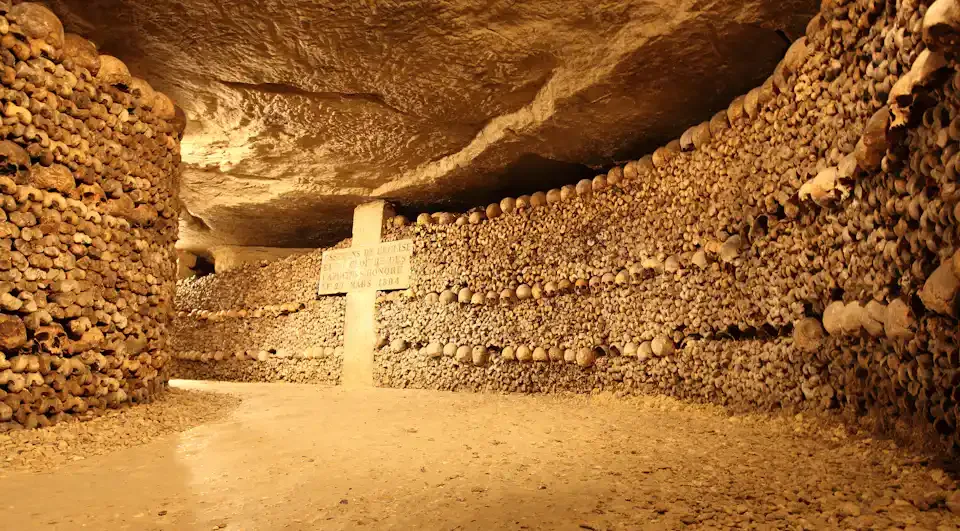
  • Keep an eye out for the large, barrel-shaped pillars and heart patterns made entirely of skulls, deliberately designed in the 19th century to transform the chaotic bone piles into a structured monument.
  • Watch for a thick black line painted along the ceiling in the early corridors, which served as a vital navigational thread to guide historical quarry workers back to the main exit before electricity was installed.

Lage und Umgebung

What kind of neighborhood

  • The Catacombes sit in Denfert-Rochereau, a practical Left Bank hub with commuters, students, and visitors mixing around a busy square.
  • The mood is more residential than postcard Paris: bakeries, market streets, quiet cemetery walls, and solid neighborhood bistros.
  • It fits a compact history-focused day: underground Paris, Montparnasse literary traces, and a calmer walk south toward Parc Montsouris.
  • This is not a luxury-shopping district; come for urban texture, everyday Paris, and easy links to the wider Left Bank.

Nearby on foot (up to 15 minutes)

  • Place Denfert-Rochereau — busy square anchored by the Lion de Belfort · 1 min
  • Lion de Belfort — bronze replica marking Parisian resistance history · 1 min
  • Rue Daguerre — lively market street for bakeries, cheese, and cafés · 4 min
  • Observatoire de Paris — historic astronomy landmark with a stately exterior · 8 min
  • Institut Giacometti — intimate museum dedicated to Alberto Giacometti · 10 min
  • Cimetière du Montparnasse — quiet graves of writers, artists, and intellectuals · 12 min
  • Parc Montsouris — landscaped park for a softer post-visit reset · 15 min
  • Villa Hallé — small villa-lined pocket with village-like Paris atmosphere · 12 min

15-30 minutes by transit

  • Tour Montparnasse — wide city views after the underground visit · 10 min by taxi
  • Musée Bourdelle — sculptor’s studios and gardens near Montparnasse · 12 min by taxi
  • Jardin du Luxembourg — classic Left Bank gardens for a slower afternoon · 15 min by metro
  • Panthéon — monumental history that pairs well with the ossuary theme · 18 min by taxi
  • Saint-Germain-des-Prés — cafés, galleries, and evening Left Bank wandering · 20 min by metro

Where to eat nearby

  • Le Cornichon — polished French bistro with market cooking · above average · reservation essential · 12 min on foot
  • Le Comptoir des Catacombes — casual French brasserie beside Denfert · mid-range · advisable to reserve · 2 min on foot
  • Aasman — Indian and Pakistani cooking on Rue Daguerre · mid-range · advisable to reserve · 6 min on foot
  • Chez An — Vietnamese neighborhood cooking near Alésia · budget · walk-in possible · 15 min on foot
  • Les Petites Sorcières — chef-led French bistro off Rue Daguerre · above average · reservation essential · 13 min on foot

Ready-made day route

Start at Place Denfert-Rochereau, see the Lion de Belfort, then visit the Catacombes de Paris before decompressing on Rue Daguerre. Continue to Institut Giacometti or Cimetière du Montparnasse, then finish with lunch or dinner at Le Cornichon if you want the strongest food stop nearby.

If the weather is good, add Parc Montsouris after the underground visit rather than before it.

NoteKeep the route compact after the Catacombes; the stairs, low ceilings, and damp air make a quiet walk more pleasant than stacking another heavy museum immediately.
Справочно

Fakten

Читать

Numbers and scale

  • Depth: 20 m below street level, equivalent to a 5-storey building and noticeably deeper than a normal basement.
  • Route length: 1.5 km one-way, so the visit is a real underground walk rather than a single chamber.
  • Stairs: 243 steps in total, with 131 down and 112 up; there is no lift or step-free route.
  • Temperature: 14°C inside, which makes a light layer useful even when Paris is warm above ground.
  • Capacity: 200 visitors are allowed on site at one time, protecting both safety and the fragile ossuary.
  • Ossuary scale: 11,000 m² of ossuary space and 800 m of ossuary galleries hold the remains of millions of Parisians.
  • Public opening: 1809, after the bones were reorganized into a more formal, museum-like route.

Myths and misconceptions

  • Myth: The entire 300 km quarry network is the Catacombs. In fact: The name properly refers to the municipal ossuary, not every tunnel under Paris.
  • Myth: The Catacombs are ancient Roman burial tunnels. In fact: They are former Paris limestone quarries converted into an 18th-century municipal ossuary.
  • Myth: The bones are arranged as full skeletons. In fact: Visible walls use skulls and long bones; smaller fragments are stacked behind.
  • Myth: This is designed as a horror attraction. In fact: It was created to solve cemetery overcrowding and public-health problems in Paris.
  • Myth: Visitors leave through the same entrance. In fact: Entry is at Place Denfert-Rochereau; the exit is at 21 bis Avenue René-Coty.

Rare and unusual

  • Port-Mahon gallery: Antoine Décure, a former soldier turned quarryman, carved scenes of Minorca into the limestone walls.
  • Samaritan Fountain: Four goldfish were placed in its basin in 1813; they survived underground but became blind.
  • Nadar experiment: In 1861, photographer Nadar used artificial light underground and posed dummies as workers for long exposures.
  • Quarriers’ Footbath: This well exposes the lower Lutetian limestone layer, making the route a small geological reference site.
  • Bone-wall technique: The visible skulls and femurs are a façade; the mass of smaller bones sits behind like quarry backfill.
  • Sepulchral Lamp: A permanent oil flame once helped move air through the galleries, not just create atmosphere.
Контекст

Geschichte

Читать

Why it matters

The Catacombes de Paris began as limestone quarries, cut beneath the city to supply the stone that built much of historic Paris. Their later purpose was very different: when overcrowded cemeteries became a public-health crisis, the tunnels were turned into a municipal ossuary.

Today’s route is not a horror attraction but a carefully arranged passage through that decision. The walls of bones make the scale of the old city visible: dense, fragile, and forced to solve practical problems underground.

For visitors, the Catacombes matter because they connect two versions of Paris at once — the elegant city above and the working, hidden city below. The experience is short, sober, and physical, with stairs, damp air, and close tunnels shaping how the history is felt.

♿ Доступность и семьи

Accessibility & family policy

  • Wheelchairs and reduced mobility: the Catacombes de Paris are not wheelchair accessible. There is no step-free route, ramp, or elevator to the ossuary: the visit involves 131 steps down and 112 steps up, plus a 1.5 km one-way underground route with narrow corridors, dim light, and uneven, sometimes slippery floors. It is not a good choice for visitors with significant mobility limits, cardiac or respiratory conditions, or claustrophobia.
  • Strollers: strollers are not allowed inside. Use a baby carrier instead; there is no cloakroom, and the exit is at 21 bis Avenue René-Coty, about 700 m from the entrance at 1 Avenue du Colonel Henri Rol-Tanguy, by Denfert-Rochereau metro/RER.
  • Children and tickets: children under 14 must be accompanied by an adult. Children under 8 enter free; children 8–17 pay 15 EUR with audioguide included.
  • Family comfort notes: plan for about 45–60 minutes underground at a constant 14°C in humid conditions. Bags are limited to 40 × 30 × 20 cm and must be carried in front or by your side. For families with young children, the main frictions are the stairs, no stroller access, narrow passages, low lighting, and the macabre setting with exposed human remains.

🏢 Что есть на площадке

On-site amenities

  • Restrooms: Toilets are available at the entrance and at the exit, with no separate toilet fee for visitors. There are no toilets inside the underground ossuary route, so use them before descending the 131 steps.
  • Food and drink: There is no on-site café or restaurant in the Catacombes. Eating and drinking are not allowed on the visit circuit; bring a small bottle for before or after the visit, but do not use it underground.
  • Shop: A gift and bookshop is part of the visitor route near the exit area. Expect books, museum publications, and Catacombs-themed souvenirs rather than a large retail space.
  • Families and comfort: Strollers are not admitted, and there is no cloakroom or lift. No dedicated nursing room, prayer room, or visitor Wi‑Fi is provided in the underground route.

Zuverlässigkeit & Aktualität

AutorAksel Paris Team
Veröffentlicht25. April 2026
Aktualisiert29. April 2026

FAQ

Do I need to book the Paris Catacombs in advance?

Yes. Entry is by timed online ticket, with sales opened 7 days ahead; full adult admission is €31 with audio guide included.

How long does a visit to the Catacombes de Paris take?

Plan about 45 minutes to 1 hour for the 1.5 km underground route, plus time to enter at your reserved slot.

Where is the entrance and which metro should I use?

The entrance is at 1 Avenue du Colonel Henri Rol-Tanguy, 75014 Paris, by place Denfert-Rochereau. Use Denfert-Rochereau station on metro lines 4 and 6 or RER B.

What are the opening hours?

The Catacombs are open Tuesday to Sunday from 9:45 to 20:30, with last admission at 19:30. They are closed on Mondays.

Is the Catacombs visit suitable for everyone?

No: the route has 131 steps down, 112 steps up, cool humid air around 14°C, and narrow underground passages. It is not recommended for claustrophobic visitors, wheelchair users, or people with mobility, heart, or respiratory difficulties.