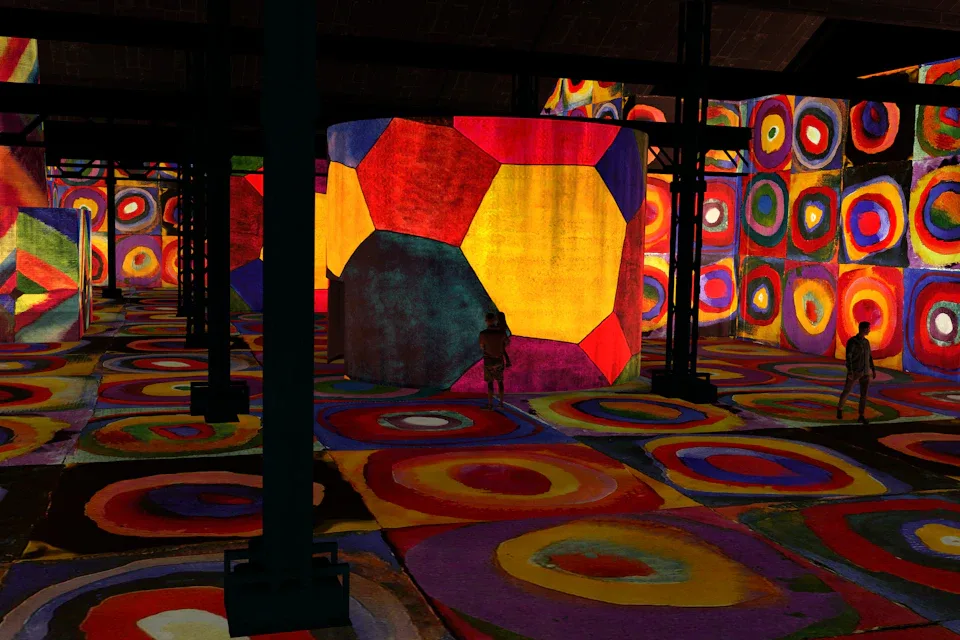
[ { "summary": "This digital art center occupies a restored 19th-century foundry in the 11th Arrondissement, using high-definition projections and spatial sound to animate classic masterpieces across its walls and floors.
It suits travelers looking for a sensory, family-friendly alternative to traditional galleries, though the experience feels more like a cinematic performance than a scholarly study.
While the immersive format is visually impressive, the dark, crowded rooms can feel overwhelming during peak hours, making a weekday morning visit the best way to appreciate the scale.", "body": "## The Vibe\nA digital art center in a 19th-century foundry using massive projections to animate classic masterpieces for a sensory, cinematic experience.\n\n## Location\nFound in the 11th Arrondissement, accessible via Metro Voltaire on Line 9 or Pere Lachaise on Lines 2 and 3.\n\n## Cost\nAdult tickets are 17 EUR, providing access to all current immersive projections within the restored industrial space.\n\n## Best Time\nArrive on a weekday morning to avoid the dense crowds that make the dark, immersive rooms feel overwhelming.\n\n## Access\nAdvance online booking is required for specific time slots; do not expect to purchase tickets at the entrance.\n\n## Time Needed\nBudget 60 minutes to experience the full rotation of the main program and the shorter contemporary features.\n\n## Trade-off\nExcellent for families and visual fans, but skip if you prefer scholarly art history over high-tech entertainment.", "best_time": "To experience the scale of the 14-meter walls without a sea of silhouettes in your way, aim for the first slot of the day at 10:00 AM on a Tuesday or Wednesday.
The foundry is dark and uses spatial audio, so when it is at full capacity on weekend afternoons, the atmosphere shifts from immersive to claustrophobic.\n\nFor photographers, the late afternoon slots on weekdays are also effective.
The light from the entrance is less intrusive, and the crowds thin out as the dinner hour approaches.
Families should stick to morning slots when energy levels are high, as the floor-to-ceiling animations can be overstimulating for younger children after a long day of sightseeing.", "ticket_block": "The experience at Atelier des Lumieres is straightforward: you are paying for a timed entry to a continuous loop of digital projections.
Because there are no physical galleries or artifacts to navigate, the standard ticket is the only one you need to see the entire show.\n\n### Which ticket to choose\nThe most important rule is that you must book your time slot online in advance.
There is no physical ticket office at the foundry, so arriving without a digital reservation usually results in being turned away.
A standard adult ticket costs 17 EUR and covers the full program, which typically includes a long feature on a famous painter and a shorter contemporary piece.\n\n- Standard Adult: Best for most visitors; provides full access to the main hall and the studio.\n- Youth/Student: Significant savings for those under 25 with valid ID.\n- Family Pass: A cost-effective option for two adults and two children.\n\nThe biggest mistake travelers make is booking a slot too late in the day during school holidays.
If you miss your entry window by more than 15 minutes, staff may deny entry to prevent overcrowding in the dark exhibition space.\n\n### Combos and discounts\nAtelier des Lumieres is frequently bundled with other digital or modern art experiences in Paris.
You can often find combo deals that pair entry with a Seine River cruise or a visit to the Musee d Orsay.
If you are traveling with a group, the Family Pass (valid for 2 adults and 2 children aged 7 to 25) offers a better per-person rate than individual tickets.\n\nChildren under the age of 7 enter for free, making this one of the more budget-friendly stops for those with toddlers.
While the venue is not included in the standard Paris Museum Pass, it is often available through the Paris Pass or Go City packages.\n\n### When a tour makes sense\nA guided tour is unnecessary for this attraction.
The experience is designed to be a sensory immersion rather than a lecture; there are no plaques to read and no artifacts to explain. The music and visuals are synchronized to tell a story on their own.\n\nYou are free to move around the space, sit on the floor, or watch from the mezzanine at your own pace.
Most visitors stay for about 60 minutes to see one full rotation of the program.
If you want deeper context, it is better to read a brief biography of the featured artist before you arrive, as the show itself focuses entirely on the visual spectacle.\n\nImportant: The venue is fully accessible for visitors with reduced mobility, including an elevator to reach the mezzanine level, though the dark environment and flashing lights may be challenging for those with sensory sensitivities.", "prime_timing_block": "This digital art center in the 11th Arrondissement transforms a 19th-century foundry into a massive canvas using high-definition projections and spatial sound.
It is a sensory performance rather than a traditional gallery visit, so do not expect to see original canvases or read detailed placards.
The experience is best enjoyed by moving around the space—sitting on the floor or heading to the mezzanine—to see how the visuals interact with the industrial architecture.\n\nWhile visually stunning, the venue can feel claustrophobic during peak weekend hours due to the dark, enclosed environment and high volume of visitors.
It is an excellent choice for families or travelers who find traditional museums tiring, but art purists seeking scholarly depth or quiet contemplation may find the cinematic format a bit superficial.
To truly appreciate the scale without a sea of silhouettes, the 10:00 AM weekday slots are the only way to go.\n\nPro Tip: Use the mezzanine for the best perspective on the floor projections, but stay on the ground level to feel fully inside the art during the main feature." } ]