Sainte Chapelle
Why visit
Lower its priority if you dislike security checks, timed entry, or paying €13 for a brief visit, or if your Paris time is limited and the weather is grey.
The chapel is beautiful rather than expansive, so come for light, glass, and medieval atmosphere — not for a long museum experience; pair it with the Conciergerie combo at €18.50 if you want the visit to feel more complete.
What to know beforehand
Sainte-Chapelle works best as a short, focused stop rather than a half-day museum visit: plan on 30–60 minutes inside, with the upper chapel as the reason to go.
It is especially rewarding for travelers who care about Gothic architecture, medieval Paris, stained glass, or quiet visual impact; visitors looking for large galleries, interactive displays, or a long narrative tour may find the visit brief for the €13 ticket.
Worth knowing: the security process is part of the experience because the entrance sits within the Palais de Justice area at 10 Boulevard du Palais. A sunny morning gives the stained glass its strongest effect, but the chapel is still a compact site, so pair it with the Conciergerie or Notre-Dame area if you want the trip to feel more substantial.

🎫 Tickets, tours & discounts
Do not pay extra expecting to bypass security
- the chapel sits inside the Palais de Justice, and checks remain strict for everyone.
Which ticket to choose
For most visitors, the standard timed ticket is enough: Sainte-Chapelle is compact, and the main experience is the upper chapel with its stained glass. A full-price visitor from outside the EEA pays €22; EEA nationals and regular EEA residents pay €16.
Pay more only if you also want the Conciergerie, which is next door and adds a strong historical layer around the medieval royal palace and the Revolution. The combined Sainte-Chapelle + Conciergerie ticket is €30 for non-EEA visitors and €23 for EEA nationals or regular residents.
- Pick the single ticket if you want a short 30–60 minute visit.
- Pick the combined ticket if you have 2–2.5 hours on Île de la Cité.
- Add the €3 audioguide if you want context without joining a tour.
- Do not pay extra expecting to bypass security: the chapel sits inside the Palais de Justice, and checks remain strict for everyone.
When to go
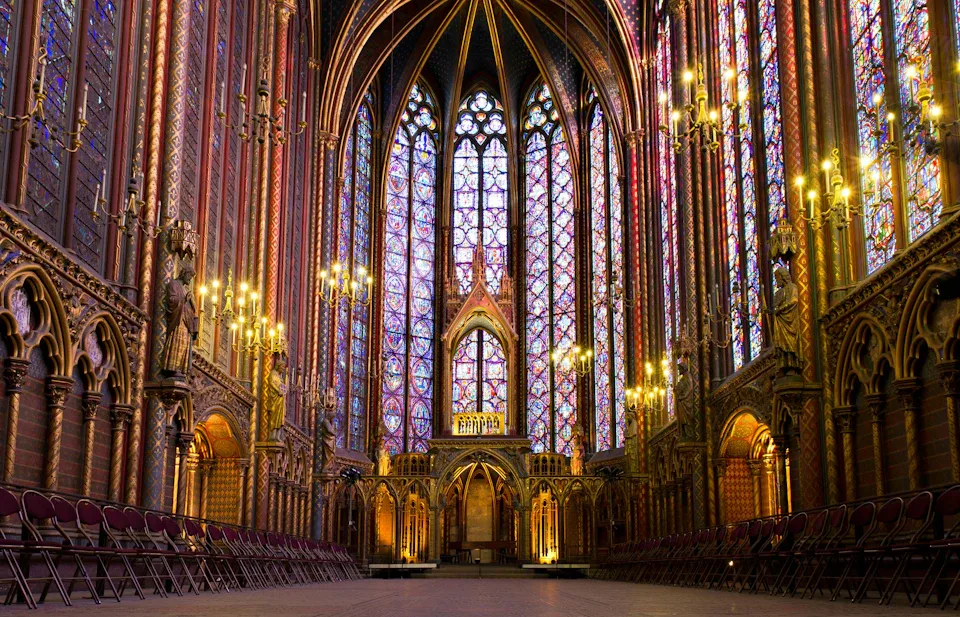
Go on a sunny morning if you can. The chapel’s impact depends heavily on light: the upper chapel is at its best when the stained glass is bright, and a grey day makes the visit noticeably flatter.
For calmer conditions, aim for the 09:00 opening slot or after 15:00. Midday has stronger light but also heavier visitor flow, tighter photo angles, and less comfort in the narrow upper chapel.
For solo travelers, early morning is the best balance of light and space. Families should choose morning to reduce waiting and fatigue. Photographers get the richest glass color on a clear day, but should expect more people in the frame if visiting around the brightest part of the day.
Combos and discounts
The only essential combo is Sainte-Chapelle + Conciergerie. It makes sense because the entrances are close, the themes connect naturally, and the Conciergerie needs about 1–1.5 hours after the chapel.
Sainte-Chapelle is also included in the Paris Museum Pass, but pass holders still need a timed slot. The pass is worthwhile if you are also visiting several major paid monuments such as the Louvre, Musée d’Orsay, Arc de Triomphe, Panthéon, Versailles, or the Conciergerie.
Admission is free for under-18s, EU nationals aged 18–25, regular non-European residents in France aged 18–25, disabled visitors with one accompanying adult, and selected other eligible categories. Free-entry visitors still need their own timed reservation and must bring proof of eligibility.
When a tour is worth it
A guided tour is useful if you want the windows to mean more than “beautiful glass.” A good guide helps decode the biblical sequence, the royal symbolism of Louis IX, and why this small chapel was built to feel like a reliquary in stone and light.
Self-guided is enough if you mainly want the visual experience, have limited time, or already know Gothic architecture. In that case, book the timed ticket, spend most of your visit upstairs, and use the audioguide if you want a light layer of explanation without committing to a full tour.

Crowd indicator
Mini-calculator based on crowd levels by day and time.
This day has average visitor density. This slot has a higher chance of a comfortable visit: fewer people and calmer pace. Weather is currently not ideal: overcast ☁️.
Nearest days
How to get there
How to find the entrance
💡 Useful tips
- Bring a pair of compact binoculars or use a camera with a strong telephoto lens to clearly see the intricate details of the biblical scenes on the uppermost glass panels.
- Read the stained glass stories by starting at the first window on the far left upon entering, following the narrative from left to right and bottom to top on each individual lancet.
- Look closely at the twelve statues of the Apostles attached to the pillars in the upper chapel to spot the six originals, which feature noticeably more weathered stone than the nineteenth-century replicas.
- Find the small, recessed alcove on the right side of the upper chapel near the altar, which served as a private oratory allowing the royal family to attend services entirely unseen.
- Turn around from the very front of the altar to view the western rose window, as this vantage point allows you to see the apocalyptic scenes straight on rather than craning your neck from directly underneath.
- Notice the intricately restored floor tiles in the upper chapel, which feature detailed enamel depictions of birds, fleurs-de-lis, and the castles of Castile that most visitors simply walk over.
BackgroundHistory
Read more
Sainte-Chapelle was built as a royal chapel inside the medieval palace on the Île de la Cité, not as a parish church. Its purpose was political as much as religious: to house precious Passion relics and present the French king as a ruler chosen and protected by God.
The building’s power is still easy to read today. The lower chapel feels enclosed and ceremonial, but the upper chapel opens into a high glass chamber where walls almost disappear behind stained glass. That contrast was intentional: visitors were meant to feel they had entered a sacred royal space.
For today’s traveler, the history matters because it explains the scale of the experience. Sainte-Chapelle is small and the visit is short, yet the ambition is immense: it is one of the clearest surviving examples in Paris of how Gothic architecture used light, color, and height to create authority and awe.
♿ Accessibility & families
Accessibility & family policy
- Wheelchair access: Sainte-Chapelle, at 10 boulevard du Palais, is accessible for visitors with reduced mobility. There is a ground-floor access ramp and an elevator to the upper chapel; the lift can take two wheelchair users at the same time. Disabled visitors and one companion enter free with valid disability proof. There are no accessible toilets at the monument, and there are no reserved PRM parking spaces immediately nearby.
- Strollers: This is not a stroller-friendly visit. Small folding strollers can pass through security screening, but strollers are not allowed in the upper chapel; they must be left with staff or in the designated area before going upstairs. Non-folding strollers have a separate handling route, but a baby carrier is the practical choice because the staircase to the upper chapel is narrow.
- Children and tickets: Children under 18 enter free for standard visits, excluding group conditions and paid workshops/tours. Everyone still goes through the Palais de Justice security checkpoint, so sharp objects, glass bottles, scooters, bulky bags and luggage are not accepted.
- Comfort notes: The visit is short, but the friction is at the entrance: security can add a wait, especially with children. The upper chapel is the main reason to visit, so families with toddlers, older visitors and anyone who struggles with stairs should plan around the narrow stair route and use staff assistance for elevator access when needed.
🏢 On-site amenities
On-site amenities
- Restrooms: There are no toilets inside the lower or upper chapel. Toilets are in the Palais de Justice complex, reached after security and before entering the chapel; access is not available on weekends and public holidays.
- Café / restaurant: There is no café, restaurant, or snack counter inside Sainte-Chapelle. For a break, use the cafés around Boulevard du Palais, Île de la Cité, or Saint-Michel before or after your visit.
- Gift shop: A small book and gift shop is available on the visitor route, selling heritage books, postcards, and Sainte-Chapelle-themed souvenirs.
- Water and families: There is no water point inside the chapel. A drinking fountain is on the pavement opposite; glass bottles are not allowed through security, but a small non-glass water bottle is the practical option. Pushchairs must be small and foldable, and they are not allowed in the upper chapel; no baby-changing table is provided.
Reliability & freshness
FAQ
Do I need to book Sainte-Chapelle in advance?
Yes, book a timed ticket in advance; the entrance is inside the Palais de Justice security area, so a reservation saves time at the ticket line.
What is the best time to visit Sainte-Chapelle?
Go on a sunny morning, ideally at 09:00, for the strongest stained-glass effect and a calmer visit. After 15:00 is the next best option.
How long should I plan for Sainte-Chapelle?
Plan 30–60 minutes for the chapel itself. It is a short visit, but the upper chapel is worth unhurried time if the light is good.
How do I get to Sainte-Chapelle by metro?
Use Cité on metro line 4 or Saint-Michel for metro and RER connections. The entrance is at 10 Boulevard du Palais, 75001 Paris, on Île de la Cité.
Are the queues and security strict at Sainte-Chapelle?
Yes, expect a strict security check because the chapel sits within the Palais de Justice complex. Arrive at the start of your booked slot and keep your bag light.