Table of contents
Conciergerie
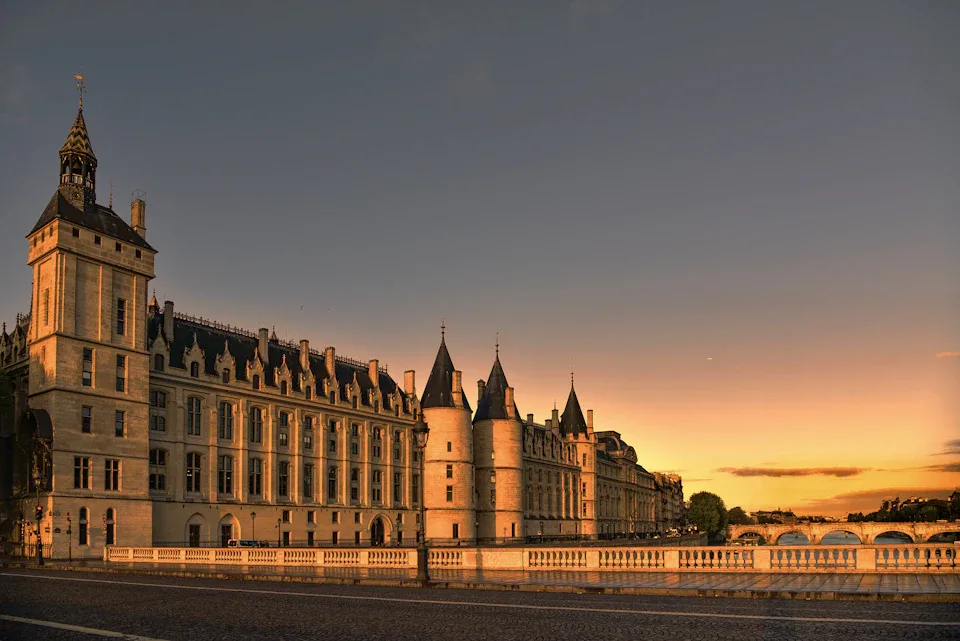
The Conciergerie is worth visiting for its medieval palace halls and the prison where Marie-Antoinette spent her final weeks. Allow 1–1½ hours for the architecture, Revolutionary history and memorial chapel. We recommend pairing it with Sainte-Chapelle when both subjects interest you; the prison visit has more reading and fewer furnished rooms than a palace tour.
| Your plan | Verdict | Reason |
|---|---|---|
| Revolution and palace halls | Conciergerie only | One indoor visit |
| History and stained glass | Combined ticket | Two neighbouring monuments |
| Only a brief stop | Exterior walk | Clock and riverside towers |

What to see inside
The medieval halls
The Salle des Gens d’Armes is the large vaulted hall at the start of the visit: 63.3 metres long, 27.4 metres wide and 8.55 metres high. Built between 1302 and 1313, it served as a refectory for the royal household’s staff. Its four fireplaces and rows of columns are the main architectural sights. On the last column of the central row, a mark records the Seine flood of January 28, 1910. The smaller Salle des Gardes, or Hall of the Guards, was an antechamber to the royal court upstairs.
The Revolutionary prison route
The prison displays explain the work of the jailers, the differences between paid and straw-bed cells, and the prisoners’ passage towards trial. The Hall of Names puts individual lives beside the political history: it records more than 4,000 people who passed through the prison before appearing before the Revolutionary Tribunal, including people who were acquitted. The Women’s Courtyard and Chapel of the Girondins add physical spaces to that story.
Marie-Antoinette: cell reconstruction and memorial
The cell display is a reconstruction. The site of Marie-Antoinette’s actual cell became a commemorative chapel in 1816, under Louis XVIII. Seeing both explains why the surviving building mixes prison history with later royalist remembrance. Her execution took place at the Place de la Révolution, now Place de la Concorde, rather than inside the Conciergerie.
Using the HistoPad
The included tablet supplies digital reconstructions of rooms in earlier periods. Stop at its marked points and compare the screen with the surviving masonry; the images are interpretations of past interiors. English visit material and the prison’s displays also explain the route, so a tablet is a supplement to the building and exhibition.
Visitor reviews describe disappointment after arriving too late to collect a tablet, and some visitors find the unfurnished halls sparse. Other visitors value being able to move through the reconstructions at their own pace. For children, a short look at the medieval rooms works better than an expectation that every prison panel will hold their attention; the exhibition deals with imprisonment and execution.
Tickets, free entry and reservations
The standard Conciergerie ticket covers the visitor route, the reconstructed prison cells, the memorial chapel and HistoPad use. The official combined ticket adds Sainte-Chapelle. The EEA category includes the European Union, Iceland, Liechtenstein and Norway; regular residence means more than four months. Bring identification and residence evidence for that rate.
| Official ticket | Price | Includes |
|---|---|---|
| Conciergerie adult | ≈ $14 (€13) | Prison and palace route |
| Combined, EEA category | ≈ $25 (€23) | Both monuments |
| Combined, other adults | ≈ $33 (€30) | Both monuments |
| Eligible free admission | $0 | Conciergerie route |
How each booking works
- Conciergerie alone: advance booking is recommended, rather than compulsory for every visitor. The ticket desk sells admission on site subject to capacity. A dated online ticket gives you a visit time to organise around.
- Combined ticket: book the Sainte-Chapelle time slot. That appointment applies to the chapel; the Conciergerie can be visited before or after it on the same day, within opening hours. Each monument has its own entrance and security line. On-site combined tickets depend on remaining chapel capacity.
- Free admission: under-18s, EU nationals aged 18–25 and regular non-European residents in France aged 18–25 qualify, as do disabled visitors and one companion with valid eligibility evidence. Reserve the appropriate free category when booking online and bring the supporting documents. Children joining a Sainte-Chapelle visit need their own free reservation too.
- Paris Museum Pass: reserve a free time slot for each monument you intend to visit. In the self-guided visit booking, use “I already have a ticket” and bring both the reservation and your valid pass.
Book Conciergerie admission or a free reservation. The reduced EEA combined ticket is sold through the Sainte-Chapelle ticket office. On the booking screen, “Visit of the monument” or “Visite libre” is the self-guided visit; guided-tour availability is a separate calendar. Travellers report mistaking a sold-out tour calendar for sold-out admission.
Everyone enters free on the first Sunday of November through March; reservations are unavailable on those days. A paid advance ticket or advertised priority access still involves the security check.
Self-guided visit or a guide?
The self-guided route gives time to read about individual prisoners and inspect the Gothic halls. A guided island walk adds context connecting the prison, chapel and cathedral; its itinerary determines which interiors are included. A cruise package adds a separate river outing, with its own departure point and boarding time.
Finding the entrance and getting there
The visitor entrance is at 2 boulevard du Palais, towards the north end of the street, near the Tour de l’Horloge and Pont au Change. Sainte-Chapelle’s entrance is farther south at number 10. Join the line signed Conciergerie rather than the chapel or courthouse queue. The ticket desk is inside the entry route.
- From Cité, Métro line 4, allow roughly 3 minutes on foot along boulevard du Palais towards the river.
- From Châtelet, lines 1, 7, 11 and 14, walk south over Pont au Change; allow roughly 7 minutes from a street exit.
- From Saint-Michel–Notre-Dame, RER B and C, cross Pont Saint-Michel and continue north along boulevard du Palais; allow roughly 8 minutes from a street exit.
Save the ticket on your phone before joining the line and carry identification: police checks also take place around the Palais de Justice. Allow extra time outdoors for screening instead of relying on a fixed queue estimate. A morning appointment leaves more room for delays than a visit close to the tablet collection cut-off.
Security, bags and clothing
Security uses bag scanners and metal detectors. Leave suitcases and bulky bags at your accommodation before travelling: the monument has neither lockers nor a cloakroom.
- Prohibited items include glass bottles, aerosols, knives, scissors and other sharp objects, motorcycle helmets, scooters, skateboards and rollerblades.
- A small day bag keeps the visit simpler. Foldable pushchairs must fit through the X-ray machine.
- Comfortable shoes help on uneven stone floors and stairs. An extra layer is useful in the stone halls; the prison route has no religious dress requirement.
The main visit is indoors, but the entrance queue and walks between monuments are outside. On a wet day, carry a compact rain layer and leave a gap between timed bookings.
Accessibility and visiting with children
The entrance requires 14 steps down, the exit 20 steps up, and the Revolutionary route has another staircase of 15 steps up and 15 down. These stairs prevent a step-free visit to the Conciergerie, including access from the street to its internal toilets. The lower halls have uneven paving. A wheelchair loan inside helps visitors who can manage the entrance stairs but tire while walking; it does not provide a way around those stairs.
There are benches and tables in the Salle des Gens d’Armes and Salle des Gardes, and benches with backs in the Hall of Names and Chapel of the Girondins. For an adapted visit, contact the visitor team on +33 1 53 40 61 04 before travelling. Guide and assistance dogs are admitted.
A baby carrier avoids carrying a pushchair on the staircases. For a family visit, leave time for the medieval halls and a few prison displays rather than trying to read every panel. The history of trials and executions needs explanation for younger children.
Nearby sights and somewhere to eat
The Conciergerie stands on the Île de la Cité. After a reserved visit to Sainte-Chapelle, allow the Conciergerie its full visit time, then continue towards Notre-Dame, roughly 10 minutes away on foot. Avoid putting a second timed attraction immediately after the prison visit.
- Place Dauphine and Pont Neuf: roughly 5 minutes west, for a bench break and a view of the Seine.
- Square du Vert-Galant: roughly 10 minutes via Pont Neuf; stairs lead down to the garden at the island’s tip.
- Shakespeare and Company: roughly 10 minutes across the river, near rue de la Bûcherie.
- Louvre: roughly 20 minutes west on foot across the Right Bank. Its palace and museum require a separate booking and a larger part of the day.
For a longer day, the Panthéon continues the theme of French political memory in the Latin Quarter. Musée d’Orsay adds an art museum visit west along the river; Le Marais lies across the Right Bank to the east. Leave these as separate parts of the day rather than squeezing them between the two island monuments.
Food within a 15-minute walk
Mich’sandwiches, 10 place Saint-Michel, is a takeaway alternative to a sit-down restaurant: sandwiches, panini and crêpes, roughly 8 minutes away across Pont Saint-Michel. It works for a quick lunch without a table booking.
Le Trumilou, 84 quai de l’Hôtel de Ville, is roughly 12 minutes away across the Seine. Its ≈ $22 (€20) starter-and-main menu and ≈ $16 (€15) vegetarian plate give a concrete sit-down budget; daily dishes change. For a longer meal facing Notre-Dame, Café Panis, 21 quai de Montebello, is roughly 10 minutes away: reserve a Café Panis table. Au Vieux Paris d’Arcole, 24 rue Chanoinesse, is another sit-down option, roughly 10 minutes away; reserve at Au Vieux Paris d’Arcole.
Facts worth noticing
The clock, cells and prison conditions
The clock tower received Paris’s first public clock in 1371. The decorated clock visible at the corner of boulevard du Palais and quai de l’Horloge has been restored, including a restoration in 2012; the whole visible clock is not an untouched medieval object.
Prison conditions depended partly on money. Prisoners able to pay could obtain a bed; poorer prisoners slept on straw. The reconstructed cells show that difference. In the Salle de la Toilette, condemned prisoners had their hair cut before leaving for execution. The Rue de Paris, a partitioned part of the medieval hall used for poorer prisoners, takes its name from “Monsieur de Paris”, the executioner.
At the height of the repression in spring 1794, as many as 600 men and women were crowded into the prison. The Hall of Names includes people condemned to death, people given other sentences and people acquitted.
From royal palace to Revolutionary prison
Key dates in the building’s history
The Conciergerie preserves the lower halls of the Palais de la Cité. The royal complex expanded under Louis IX and Philip IV; its medieval kitchens date from around 1353. The kings left the island palace as a residence during the 14th century, while its courts and administration remained. The royal concierge’s responsibilities gave the prison its name.
The Revolutionary Tribunal was installed in the palace in March 1793. Marie-Antoinette arrived at the Conciergerie on August 2, 1793; her trial began on October 14 and she was executed on October 16. Danton, Olympe de Gouges and Robespierre were also held here during the Revolution.
The building continued to function as a prison after the Revolution. It opened partly to visitors in 1914, and prison use ended in 1934. The visitor route covers only part of the wider Palais de Justice complex.
Facilities inside
Toilets are available within the monument, beyond the entrance stairs. The bookshop sells history books and souvenirs at the end of the route. There is no café or restaurant inside; plan your food stop after leaving.
Questions before visiting
Can official tickets be changed or refunded?
Official admission tickets are neither exchangeable nor refundable. A partner booking has the cancellation conditions shown for that particular offer.
Can I bring a pet in a bag?
Pets are not admitted, including in bags. Guide and assistance dogs are admitted with the relevant documentation.
Is English available for a visit without a guide?
Yes. English is available among the visitor languages for the HistoPad and the visit leaflet.
Can I visit the towers or get a rooftop view?
The admission route covers the medieval halls and prison exhibition. The exterior towers are visible from the quays; this ticket has no rooftop viewing platform.
Our recommendation
Buy the combined ticket for a day devoted to the island’s history, because the chapel and prison show different parts of the same royal complex. For the Conciergerie alone, the standard ticket covers the full visitor route; arriving before the tablet collection cut-off leaves time to use the digital reconstructions alongside the exhibition.
Reliability & freshness

Aksel Paris
Aksel Paris editorial team
Practical Paris guide for independent travellers
We are the editorial team behind Aksel Paris, an independent Paris guide for readers who plan their own trip. We write about attractions, neighbourhoods, transport and the practical side of a visit: what a ticket costs, how long a place takes, when to go and what is worth booking.
About the editorial team →