Warum besuchen

Für wen es perfekt ist

Prioritize Père-Lachaise if you want a quiet, self-guided Paris walk with real historical weight rather than a conventional museum visit. It is especially rewarding for travelers interested in literature, music, sculpture, funerary art, and famous graves, with free entry and a large landscape of avenues, tombs, and memorials in the 20th arrondissement.

Wer es lieber auslässt

Skip it or lower its priority if you have limited time, poor mobility, or little interest in wandering through a cemetery setting: the site is extensive, uneven, and not suited to a rushed stop. Practical verdict: go when you can give it unhurried time, wear comfortable shoes, and treat it as a reflective walk rather than a checklist attraction.

Was Sie vorher wissen sollten

Editor’s note: Père-Lachaise works best when treated as a long, quiet walk rather than a quick “famous graves” stop. The site is large, hilly in places, and easier to enjoy with comfortable shoes, a simple route, and enough time to wander without turning the visit into a navigation exercise.

Best forTravelers who like history, literature, music, sculpture, and atmospheric Paris beyond the main museums. Visitors looking for a compact, high-impact attraction may leave underwhelmed, especially if they arrive late, rush between names, or expect a polished museum-style experience.

🎫 Tickets, Touren & Rabatte

Which ticket to choose

For Père-Lachaise, the “basic ticket” is the right choice for most visitors: entry to the cemetery is free, and there is no paid fast-track, VIP entrance, or premium access level that improves the visit.

You can walk in independently, use the cemetery map, and build your own route around names such as Oscar Wilde, Jim Morrison, Édith Piaf, Frédéric Chopin, Marcel Proust, and many others.

Paying more only makes sense if you are buying interpretation, not access. A guided walk or audio guide can be worth it if you want stories, historical context, and help navigating a large 43-hectare site with uneven paths.

  • Free self-guided visit: best for independent travelers, repeat visitors, and anyone comfortable reading a map.
  • Audio guide: useful if you want structure but still prefer to move at your own pace.
  • Guided tour: best for first-timers who care about history, symbolism, literature, music, or Parisian funerary culture.
ImportantThe common first-time mistake is paying for something that sounds like an “entry ticket.” Entry itself is free; the paid product should be a tour, guide, or route aid.

When to go

Morning is the most comfortable time to visit. The paths are quieter, the atmosphere is calmer, and it is easier to stop at famous graves without feeling rushed. The cemetery opens at 8:00 on weekdays, 8:30 on Saturdays, and 9:00 on Sundays and public holidays.

Late afternoon can be beautiful for photos, especially on tree-lined avenues and around sculptural tombs, but it leaves less margin because the cemetery closes at 17:30 in the shorter-day season and 18:00 in the longer-day season. Last admission is 15 minutes before closing, which is too late for a meaningful visit.

For solo travelers, go in the morning and allow at least 2 hours. For families, choose a dry morning or early afternoon and keep the route short. For photographers, late afternoon gives better light, but plan a focused route rather than trying to cover the whole cemetery.

Combos and discounts

There is no useful money-saving combo for Père-Lachaise entrance because admission is already free. Paid products sold around the cemetery are mainly guided walks, private tours, or audio-based experiences; they should be judged on content and group size rather than on “discounted entry.”

Paris city passes are not a major factor here for the same reason: there is no entrance fee to reduce. Children, students, residents, and seniors do not need a special discount for admission, because the base visit costs €0.

TipIf you want to save money, skip packaged “entry” offers and spend only on a guide if you genuinely want narration and orientation.

When a tour makes sense

A guided tour adds real value at Père-Lachaise because the cemetery is large, layered, and easy to under-read. A good guide can connect the graves to Paris history, revolutions, artistic movements, funerary symbols, and the quieter stories behind the famous names.

Take a tour if this is your first visit, if you have limited time, or if you want more than a list of celebrity graves. Skip it if you mainly want a reflective walk, photography, or a flexible route at your own pace; a self-guided visit is enough if you are comfortable navigating uneven alleys and spending 2–3 hours on foot.

Wetter jetzt
Paris, Frankreich
JetztClear night 🌙
Temperatur19°C
SichtExcellent
AerosoleClean air · AOD 0.10

Good conditions for visiting today.

AOD — wie stark Staub und Dunst in der Luft die Fernsicht dämpfen. 0 sauber, >0,4 spürbar, >0,7 stark.

Überfüllungsanzeige

Mini-Rechner basierend auf Überfüllungsleveln nach Tag und Uhrzeit.

Wann hingehen?

Mini-Rechner basierend auf Überfüllungsleveln nach Tag und Uhrzeit.

Beste Zeit um Пн — 18:00

Dieser Tag ist normalerweise ruhiger als der Durchschnitt. Dieser Slot hat eine höhere Chance auf einen angenehmen Besuch: Kompromiss zwischen Licht und Besucherstrom.

30–50% · Ruhig60–80% · Mäßig90–100% · Überfüllt

Nächste Tage

Сегодня
10:0032%
12:0043%
14:0052%
16:0057%
17:0050%
18:0018%
Завтра
10:0033%
12:0045%
14:0054%
16:0059%
17:0052%
18:0018%
Послезавтра
10:0038%
12:0050%
14:0060%
16:0066%
17:0060%
18:0020%

Wie man den Eingang findet

1
Start at Philippe AugusteUse metro line 2 and walk to the main gates on Boulevard de Ménilmontant.
2
Use 16 Rue du ReposTreat this as your map pin; Père-Lachaise has several entrances on different streets.
3
Enter open groundsThere is no mall, museum lobby, ticket desk, or standard security line at the gate.
4
Plan inside routeFollow the cemetery map from the entrance; paths are long, uneven, and famous graves are spread out.

Use the main cemetery address: 8 Boulevard de Ménilmontant, 75020 Paris. For the simplest arrival, use Philippe Auguste metro station on Line 2; it is closest to the main gate. Père Lachaise station on Lines 2 and 3 is also nearby, but it brings you toward a side approach, which can feel confusing on a first visit.

There is no paid entrance desk for an independent visit: entry to the cemetery itself is free. If you booked a tour or audio product, that booking is for the guiding service, not for a special gate or fast-track cemetery access.

The main delay is not check-in or security; it is orientation once you are inside. The site is large, sloped in places, and paved with uneven paths, so expect to lose time finding specific graves and moving between sections.

ImportantDo not treat Père-Lachaise as a quick stop. Wear comfortable shoes, enter with a route in mind, and allow enough time for a slow walk through the 20th arrondissement’s largest and most atmospheric cemetery.

Praktische Einschränkungen und was mitzunehmen

What to consider before visiting

Père-Lachaise is an active cemetery, not a conventional museum. There is no formal dress code, but dress and behave respectfully: keep voices low, do not sit or climb on tombs, and give space to families attending funerals or visiting graves.

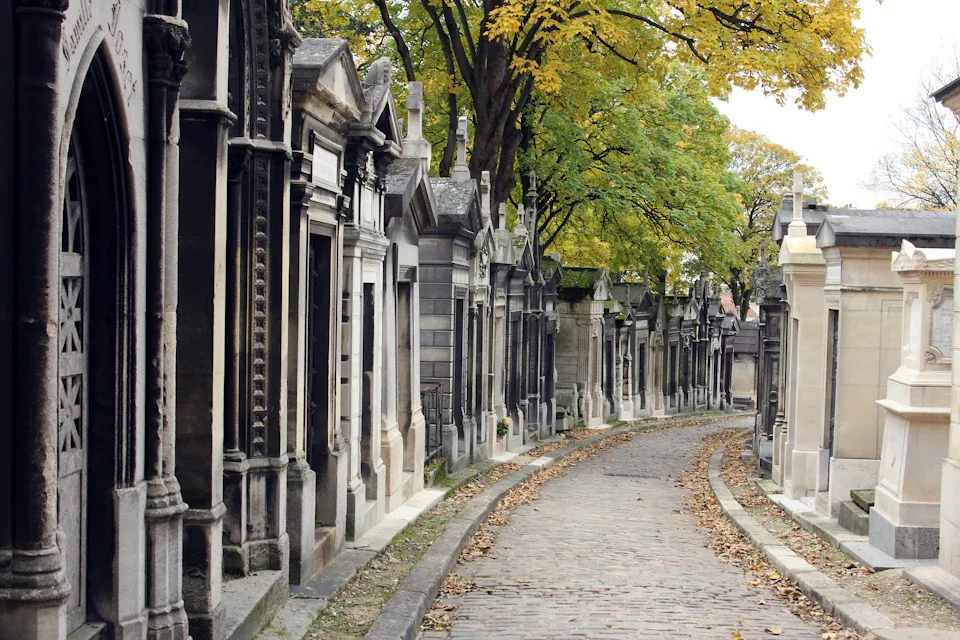
The site is large — about 43 hectares — with long avenues, cobbled or uneven paths, slopes, and some entrances that involve stairs. Comfortable shoes matter more than smart clothing. Allow at least 2 hours if you want more than a quick look at one or two famous graves.

There are no age limits. Strollers can be used, but routes are not equally smooth: for an easier first visit, use the main entrance by Boulevard de Ménilmontant near Philippe Auguste metro, line 2, or plan a downhill route from Gambetta.

What you can and cannot bring

  • Alcohol is not allowed.
  • Picnics are not allowed.
  • Sound equipment and musical instruments are not allowed without special authorisation.
  • Animals are not allowed, even on a leash.
  • Bicycles, scooters and similar wheeled vehicles are not allowed, even if pushed by hand.
  • Jogging, fitness and other sports are not allowed.
  • Treasure hunts, escape-game-style visits and organised games are not allowed.
  • Feeding animals is not allowed.
  • A water bottle is fine and useful.
  • A small day bag is practical for water, a phone battery, a paper map and weather layers.
  • Personal photography is acceptable when done discreetly and without disturbing mourners or ceremonies.
ImportantDo not treat the cemetery like a park. Stay on paths, avoid stepping between graves, and keep food for before or after the visit.

Storage and belongings

There is no museum-style cloakroom or locker system at Père-Lachaise, so arrive with only what you are ready to carry. Large suitcases are a poor fit for the site: the paths are uneven, distances are long, and there is no convenient place to leave luggage at the gates.

Strollers can come in, but they are easier on the broader avenues than on narrow, sloped or older sections. For luggage, use your hotel, apartment host or a city luggage-storage service elsewhere in Paris before going to the cemetery.

💡 Nützliche Tipps

  • The cobblestones in the older sections, particularly along the steep descent from the Gambetta entrance, become extremely slippery after rain and require high-traction soles.
  • GPS signals frequently bounce under the dense tree canopy, making phone navigation unreliable, so take a high-resolution photo of the large physical map displayed at the main gate before walking inward.
  • While crowds gather around Chopin's resting place in Division 11, most completely miss the nearby tomb of Alexandre-Théodore Brongniart, the architect who actually designed the cemetery's original layout.
  • The only way to photograph Jim Morrison's grave in Division 6 without a crowd of onlookers is to arrive exactly at the weekday opening time, well before the first guided tours reach that sector around 9:30 AM.
  • If you walk near the quieter eastern walls around Divisions 87 through 94 during the last hour before closing, you have a high chance of spotting the cemetery's resident foxes and semi-wild cats.
  • Do not rely solely on the division numbers carved into the stone corner markers at intersections, as weathering has made many of the 19th-century numerals entirely illegible.
  • Fans of early cinema should seek out the often-missed grave of Georges Méliès in Division 64, where visitors maintain a quiet tradition of leaving small vintage cinema tickets on the bust.

Lage und Umgebung

What kind of area

  • Père-Lachaise sits between the 20th and the eastern edge of the 11th arrondissement: residential, hilly, and less polished than central Paris.
  • The day suits walkers who like history, street corners, small bistros, and quiet gardens more than luxury shopping or monument-hopping.
  • The cemetery is large and uneven, so the surrounding plan should stay compact: one cultural stop, one neighborhood walk, and a meal.
  • Ménilmontant, Charonne, and Belleville add a local Paris feel nearby, with studios, bars, bakeries, and small restaurants.

Nearby on foot (within 15 minutes)

  • Square Samuel de Champlain — small garden with Père-Lachaise wall memorials · 3 min
  • Jardin Naturel Pierre-Emmanuel — wild-feeling pocket garden beside cemetery walls · 6 min
  • Passage de la Folie-Regnault — quiet cobbled lane of old workshops · 8 min
  • Square de la Roquette — local pause after the cemetery’s steeper paths · 10 min
  • Atelier des Lumières — immersive digital art in a former foundry · 15 min
  • Église Notre-Dame-de-la-Croix de Ménilmontant — grand 19th-century church above Ménilmontant · 15 min
  • Pavillon Carré de Baudouin — free neighborhood art center in Ménilmontant · 15 min
  • La Campagne à Paris — village-like hilltop streets with small houses · 15 min

15-30 minutes by transport

  • Place de la Bastille — easy next stop for Marais or canal plans · 15 min by metro
  • Place des Vosges — elegant arcaded square for a calmer Marais finish · 20 min by metro
  • Canal Saint-Martin — waterside cafes and bridges after a cemetery walk · 20 min by metro
  • Parc de Belleville — open city views and a steeper local neighborhood · 20 min by taxi
  • Musée Carnavalet — Paris history that pairs well with famous graves · 25 min by metro

Where to eat nearby

  • Septime — modern tasting-menu landmark on Rue de Charonne · expensive · reservation essential · 8 min by taxi
  • Le Baratin — Belleville bistro and natural-wine cellar · above average · booking recommended · 8 min by taxi
  • Cachette — polished small-plate cooking near Gambetta · above average · booking recommended · 8 min walk
  • Le Piston Pélican — neighborhood bistro-bar by Rue de Bagnolet · mid-range · walk-ins possible · 8 min walk

Ready-made day route

Start with Cimetière du Père-Lachaise while you still have energy for its slopes, then step out toward Jardin Naturel Pierre-Emmanuel and La Campagne à Paris for a softer residential contrast. Continue to Pavillon Carré de Baudouin or Atelier des Lumières, then finish with dinner at Le Baratin if you want a classic eastern-Paris bistro evening.

NoteKeep the day east of Bastille; adding the Eiffel Tower or Louvre turns a compact neighborhood plan into a cross-city transfer day.
Справочно

Fakten

Читать

Numbers and Scale

  • Area: 43.20 hectares, so distances feel closer to a park hike than a short cemetery stop.
  • Graves: 70,000 burial plots, making navigation by division number essential for famous tombs.
  • Burials: 1,000,000 people have been buried here, far beyond the visible number of tombs.
  • Opening: 1804, making it one of the key Napoleonic-era changes to how Paris handled burial.
  • Visitors: 3.5 million a year, giving it the scale of a major Paris attraction despite its quiet setting.
  • Columbarium: 26,000 niches, a reminder that Père-Lachaise is still an active funerary site.
  • Crematorium: France’s first cremation here took place on 30 January 1889, inside the cemetery complex.

Myths and Misconceptions

  • Myth: Père-Lachaise was fashionable from its first day. In reality: It opened outside central Paris and struggled until famous remains were transferred.
  • Myth: It is named after a cemetery director. In reality: The name comes from François de La Chaise, confessor to Louis XIV.
  • Myth: Chopin’s heart is buried with his body. In reality: His body is here; his heart is in Holy Cross Church in Warsaw.
  • Myth: Oscar Wilde’s glass screen was part of the original tomb. In reality: It was added to protect the stone from lipstick kisses and graffiti.
  • Myth: Jim Morrison’s grave still has its famous bust. In reality: The bust was stolen in 1988 and no longer stands on the grave.

Rare and Unusual

  • Victor Noir’s bronze tomb has polished lips, shoes, and groin from a long-running fertility superstition.
  • The Mur des Federes marks where 147 Paris Commune prisoners were shot at the cemetery wall in 1871.
  • The crematorium and columbarium form a working funerary complex, not a decorative monument for visitors.
  • The cinerary lawn receives 1,300 ash scatterings a year, hidden in plain sight inside the museum-like grounds.
  • Jim Morrison’s stolen marble bust was recovered after 37 years, but the grave remains deliberately plain.
  • The cemetery’s ecosystem includes foxes, tawny owls, and feral cats, a side of Père-Lachaise missed on grave-only routes.
Контекст

Geschichte

Читать

Why it matters

Père-Lachaise was created as a new kind of Paris cemetery: set away from the dense historic center, landscaped with trees, paths, slopes, and monuments rather than laid out as a simple burial ground. Its purpose was practical, but its design turned mourning into a public walk through architecture, sculpture, and memory.

The cemetery became important because Paris gradually placed major cultural and political figures here, making it feel less like a single monument and more like a map of French and international history.

Writers, musicians, artists, performers, and public figures share the same landscape with family tombs, chapels, and memorials, so the visit is as much about atmosphere as famous names.

For today’s visitor, the value is in the mix: quiet lanes, uneven stone paths, grand mausoleums, modest graves, and places tied to collective memory. It is not a museum with one fixed route; it rewards slow wandering, a few chosen graves, and enough time to let the setting explain why Père-Lachaise remains one of Paris’s most meaningful historic spaces.

♿ Доступность и семьи

Accessibility & family policy

  • Wheelchair users: Père-Lachaise is only partially accessible. Entry is free and step-free routes exist from the main gates, but this is a 43-hectare historic cemetery with steep gradients, cobblestones, uneven paving, narrow grave-side paths, and sections with steps. There are no elevators; the most comfortable wheelchair visit is a short, planned route on the wider avenues rather than a full cemetery circuit.
  • Strollers: Strollers are allowed inside and do not need to be left at the entrance. Use a sturdy stroller rather than a lightweight travel buggy: many famous graves are reached by sloped lanes, rough surfaces, and tight side paths where you may need to park the stroller briefly and walk a few metres.
  • Children and tickets: Admission is free for everyone, so there is no child ticket or free-entry age band to calculate. There is no attraction-style age limit, but children should stay with adults throughout the visit because Père-Lachaise is an active cemetery, not a playground or park.
  • Reduced-mobility comfort notes: Plan for a quiet 1–2 hour visit, wear supportive shoes, and avoid trying to “see everything.” Benches and toilets are limited, queues are not the main issue, but distance, slopes, cobbles, and the lack of frequent rest points are. For families under 12, frame the visit as a calm outdoor walk and keep noise low around funerals and graves.

🏢 Что есть на площадке

On-site amenities

  • Restrooms: There are public toilets inside Père-Lachaise, marked as “Toilettes” on the cemetery map. The site is open-air, so there is no floor level to navigate; facilities are at ground level and are free to use.
  • Food and drink: There is no café, restaurant, or museum-style refreshment area inside the cemetery. Picnics and alcohol are not allowed. Bring a water bottle; drinking fountains are available in the grounds, but all fountains are shut during winter.
  • Shop: There is no on-site gift shop. Maps are available free of charge, and any guidebooks, flowers, or souvenirs are found outside the cemetery, around the surrounding streets and metro exits.
  • Wi-Fi and family facilities: Do not plan on site-wide visitor Wi-Fi; use mobile data or an offline map. There are no dedicated nursing rooms, baby-changing rooms, or prayer rooms inside the visitor route.

Zuverlässigkeit & Aktualität

AutorAksel Paris Team
Veröffentlicht25. April 2026
Aktualisiert29. April 2026

FAQ

Do I need to book Père-Lachaise Cemetery in advance?

Yes for an Aksel Paris visit: reserve your slot even though entry to the cemetery itself is free.

What is the best time to visit Père-Lachaise Cemetery?

Go in the morning for a quieter walk and better energy for the slopes and uneven paths. The cemetery is open daily: 8:00–18:00 Monday–Friday, 8:30–18:00 Saturday, and 9:00–18:00 Sunday and public holidays.

How long should I plan for Père-Lachaise Cemetery?

Allow at least 1.5–2 hours for a first visit, and more if you want to find several famous graves without rushing. It is too large and hilly to treat as a quick 20-minute stop.

How do I get to Père-Lachaise Cemetery by metro?

Use Père Lachaise station on Metro lines 2 and 3, or Gambetta station on line 3 for an entrance near the upper side of the cemetery. The main address is 16 Rue du Repos, 75020 Paris.

Are there queues or difficult access at Père-Lachaise Cemetery?

There is no paid-entry queue like at a museum, but popular graves and narrow paths can get busy. Wear comfortable shoes: the site has cobblestones, slopes, stairs, and uneven ground.