Prioritize Père-Lachaise if you want a quiet, self-guided Paris walk with real historical weight rather than a conventional museum visit. It is especially rewarding for travelers interested in literature, music, sculpture, funerary art, and famous graves, with free entry and a large landscape of avenues, tombs, and memorials in the 20th arrondissement.
Cimetière du Père-Lachaise
Why visit
Skip it or lower its priority if you have limited time, poor mobility, or little interest in wandering through a cemetery setting: the site is extensive, uneven, and not suited to a rushed stop. Practical verdict: go when you can give it unhurried time, wear comfortable shoes, and treat it as a reflective walk rather than a checklist attraction.
What to know beforehand
Editor’s note: Père-Lachaise works best when treated as a long, quiet walk rather than a quick “famous graves” stop. The site is large, hilly in places, and easier to enjoy with comfortable shoes, a simple route, and enough time to wander without turning the visit into a navigation exercise.
🎫 Tickets, tours & discounts
Самостоятельный аудиомаршрут по кладбищу (Père Lachaise Cemetery Audio Guide)
- загружаемый аудиогид для смартфона
- самостоятельный маршрут без группы
- остановки у известных могил, включая Джима Моррисона и Оскара Уайльда
- вход на кладбище бесплатный и отдельный билет не требуется
Групповая пешеходная экскурсия (Père Lachaise Cemetery Guided Walking Tour)
- пешеходная экскурсия с лицензированным гидом
- обычно около 2 часов на территории кладбища
- маршрут по ключевым аллеям и знаменитым захоронениям
- встреча у ближайшей станции метро или входа
Тематическая экскурсия по знаменитым могилам (Père Lachaise Cemetery Famous Graves Tour)
- акцент на могилах музыкантов, писателей и артистов
- остановки у Джима Моррисона, Эдит Пиаф и Оскара Уайльда
- комментарии гида об истории кладбища и символике надгробий
- групповой формат без трансфера из отеля
Частная экскурсия по Père-Lachaise (Père Lachaise Cemetery Private Tour)
- индивидуальный гид только для вашей компании
- настраиваемый маршрут по интересующим могилам
- обычно 2–3 часа прогулки по кладбищу
- удобный темп без большой группы
Which ticket to choose
For Père-Lachaise, the “basic ticket” is the right choice for most visitors: entry to the cemetery is free, and there is no paid fast-track, VIP entrance, or premium access level that improves the visit.
You can walk in independently, use the cemetery map, and build your own route around names such as Oscar Wilde, Jim Morrison, Édith Piaf, Frédéric Chopin, Marcel Proust, and many others.
Paying more only makes sense if you are buying interpretation, not access. A guided walk or audio guide can be worth it if you want stories, historical context, and help navigating a large 43-hectare site with uneven paths.
- Free self-guided visit: best for independent travelers, repeat visitors, and anyone comfortable reading a map.
- Audio guide: useful if you want structure but still prefer to move at your own pace.
- Guided tour: best for first-timers who care about history, symbolism, literature, music, or Parisian funerary culture.
When to go
Morning is the most comfortable time to visit. The paths are quieter, the atmosphere is calmer, and it is easier to stop at famous graves without feeling rushed. The cemetery opens at 8:00 on weekdays, 8:30 on Saturdays, and 9:00 on Sundays and public holidays.
Late afternoon can be beautiful for photos, especially on tree-lined avenues and around sculptural tombs, but it leaves less margin because the cemetery closes at 17:30 in the shorter-day season and 18:00 in the longer-day season. Last admission is 15 minutes before closing, which is too late for a meaningful visit.
For solo travelers, go in the morning and allow at least 2 hours. For families, choose a dry morning or early afternoon and keep the route short. For photographers, late afternoon gives better light, but plan a focused route rather than trying to cover the whole cemetery.
Combos and discounts
There is no useful money-saving combo for Père-Lachaise entrance because admission is already free. Paid products sold around the cemetery are mainly guided walks, private tours, or audio-based experiences; they should be judged on content and group size rather than on “discounted entry.”
Paris city passes are not a major factor here for the same reason: there is no entrance fee to reduce. Children, students, residents, and seniors do not need a special discount for admission, because the base visit costs €0.
When a tour makes sense
A guided tour adds real value at Père-Lachaise because the cemetery is large, layered, and easy to under-read. A good guide can connect the graves to Paris history, revolutions, artistic movements, funerary symbols, and the quieter stories behind the famous names.
Take a tour if this is your first visit, if you have limited time, or if you want more than a list of celebrity graves. Skip it if you mainly want a reflective walk, photography, or a flexible route at your own pace; a self-guided visit is enough if you are comfortable navigating uneven alleys and spending 2–3 hours on foot.
Crowd indicator
Mini-calculator based on crowd levels by day and time.
This day is usually calmer than average. This slot has a higher chance of a comfortable visit: compromise between light and visitor flow.
Nearest days
How to find the entrance
Go to Cimetière du Père-Lachaise in the 20th arrondissement. The practical address for the main entrance is 28 ter boulevard de Ménilmontant, 75020 Paris; the historic address often used for the cemetery is 16 rue du Repos.
The nearest metro for the main gate is Philippe Auguste on Line 2; Père Lachaise station on Lines 2 and 3 serves a side entrance, not the main gate.
The confusing part is that the cemetery has several gates, and “Père Lachaise” metro does not automatically mean you are at the main entrance. If your booking or meeting point names Porte Principale, aim for boulevard de Ménilmontant. If it names Porte Gambetta, use Gambetta station on Line 3 or 3bis and enter from rue des Rondeaux.
- Entry to the cemetery itself is free.
- Your reservation relates to the visit format, route, or guided arrangement, not to a paid museum-style ticket.
- There is no mall routing; the delay is mostly from finding the correct gate and orienting yourself once inside.
Practical limits & what to bring
What to consider before visiting
Père-Lachaise is an active cemetery, not a conventional museum. There is no formal dress code, but dress and behave respectfully: keep voices low, do not sit or climb on tombs, and give space to families attending funerals or visiting graves.
The site is large — about 43 hectares — with long avenues, cobbled or uneven paths, slopes, and some entrances that involve stairs. Comfortable shoes matter more than smart clothing. Allow at least 2 hours if you want more than a quick look at one or two famous graves.
There are no age limits. Strollers can be used, but routes are not equally smooth: for an easier first visit, use the main entrance by Boulevard de Ménilmontant near Philippe Auguste metro, line 2, or plan a downhill route from Gambetta.
What you can and cannot bring
- Alcohol is not allowed.
- Picnics are not allowed.
- Sound equipment and musical instruments are not allowed without special authorisation.
- Animals are not allowed, even on a leash.
- Bicycles, scooters and similar wheeled vehicles are not allowed, even if pushed by hand.
- Jogging, fitness and other sports are not allowed.
- Treasure hunts, escape-game-style visits and organised games are not allowed.
- Feeding animals is not allowed.
- A water bottle is fine and useful.
- A small day bag is practical for water, a phone battery, a paper map and weather layers.
- Personal photography is acceptable when done discreetly and without disturbing mourners or ceremonies.
Storage and belongings
There is no museum-style cloakroom or locker system at Père-Lachaise, so arrive with only what you are ready to carry. Large suitcases are a poor fit for the site: the paths are uneven, distances are long, and there is no convenient place to leave luggage at the gates.
Strollers can come in, but they are easier on the broader avenues than on narrow, sloped or older sections. For luggage, use your hotel, apartment host or a city luggage-storage service elsewhere in Paris before going to the cemetery.
💡 Useful tips
- The cobblestones in the older sections, particularly along the steep descent from the Gambetta entrance, become extremely slippery after rain and require high-traction soles.
- GPS signals frequently bounce under the dense tree canopy, making phone navigation unreliable, so take a high-resolution photo of the large physical map displayed at the main gate before walking inward.
- While crowds gather around Chopin's resting place in Division 11, most completely miss the nearby tomb of Alexandre-Théodore Brongniart, the architect who actually designed the cemetery's original layout.
- The only way to photograph Jim Morrison's grave in Division 6 without a crowd of onlookers is to arrive exactly at the weekday opening time, well before the first guided tours reach that sector around 9:30 AM.
- If you walk near the quieter eastern walls around Divisions 87 through 94 during the last hour before closing, you have a high chance of spotting the cemetery's resident foxes and semi-wild cats.
- Do not rely solely on the division numbers carved into the stone corner markers at intersections, as weathering has made many of the 19th-century numerals entirely illegible.
- Fans of early cinema should seek out the often-missed grave of Georges Méliès in Division 64, where visitors maintain a quiet tradition of leaving small vintage cinema tickets on the bust.
Location and what's nearby
Что за район
- 20-й округ здесь тихий и жилой: меньше витринного Парижа, больше камня, зелени, рынков и соседских кафе.
- День вокруг Père-Lachaise лучше планировать как медленную прогулку: аллеи кладбища, холмы, маленькие площади и бистро без музейной спешки.
- Район подходит тем, кто любит историю, литературу, музыку и восточный Париж с более локальным ритмом.
- После визита логично уходить в сторону Ménilmontant, Belleville или Charonne: там больше жизни, баров и ужинов.
Рядом пешком (до 15 минут)
- Square Samuel de Champlain — тихий сквер у стены кладбища · 3 мин
- Jardin naturel Pierre-Emmanuel — дикий сад с тропинками и птицами · 5 мин
- Place Gambetta — живая районная площадь с террасами · 10 мин
- Square Édouard-Vaillant — зелёная пауза у mairie du 20e · 10 мин
- Église Saint-Germain de Charonne — старая церковь деревенского Charonne · 15 мин
- La Campagne à Paris — мини-квартал с домиками и садами · 15 мин
В 15–30 минут на транспорте
- Atelier des Lumières — иммерсивное искусство после исторической прогулки · 10 мин на такси
- Place de la Bastille — сильная городская связка с восточным Парижем · 15 мин на метро
- Parc des Buttes-Chaumont — холмы, виды и более просторная прогулка · 20 мин на метро
- Place des Vosges — классический Marais после тихого Père-Lachaise · 20 мин на метро
- Canal Saint-Martin — бары, мостики и вечерняя прогулка у воды · 25 мин на метро
Где поесть рядом
- Le Baratin — культовое бистро Belleville и винная карта · выше среднего · бронь обязательна · 10 мин на такси
- Septime — Michelin-звезда и современная французская кухня · дорого · бронь обязательна · 10 мин на такси
- Le Perchoir Ménilmontant — rooftop, коктейли и вид на восток Парижа · выше среднего · желательно забронировать · 15 мин пешком
- Aux Ours — соседское бистро рядом с Gambetta · средний · желательно забронировать · 8 мин пешком
Готовый маршрут на день
Начните с Cimetière du Père-Lachaise и проходите его без спешки, затем выйдите к Square Samuel de Champlain и Place Gambetta. После короткой паузы дойдите до La Campagne à Paris или Église Saint-Germain de Charonne, а на ужин уходите в Le Baratin, если хочется сильного бистро-финала в Belleville.
ReferenceFacts
Read more
Цифры и масштаб
- Открытие: 21 мая 1804 — кладбище относится к наполеоновской реформе захоронений за пределами плотного центра Парижа.
- Площадь: 43,20 га — прогулка ощущается как отдельный городской квартал, а не как короткая остановка.
- Могилы: 70 000 — без плана легко потерять время между похожими аллеями и дивизионами.
- Захоронения: до 1 000 000 человек — многие участки связаны не с одной персоной, а с несколькими поколениями.
- Дивизионы: 97 — могилы знаменитостей ищут по номеру сектора, а не только по имени.
- Мемориалы: 55 памятников депортированным и ветеранам — это важное место памяти, а не только «кладбище знаменитостей».
- Расширения: 5 этапов в 1824, 1829, 1832, 1842 и 1850 годах — поэтому планировка неоднородная и местами запутанная.
Мифы и заблуждения
- Миф: Père-Lachaise сразу стал престижным местом захоронения. На самом деле: в первый год здесь было только 13 могил.
- Миф: Название связано с первым похороненным человеком. На самом деле: оно идет от Франсуа де Ла Шеза, духовника Людовика XIV.
- Миф: Это старое католическое кладбище при церкви. На самом деле: Père-Lachaise изначально был муниципальным и внеконфессиональным кладбищем.
- Миф: Поцелуи на могиле Оскара Уайльда разрешены. На самом деле: стеклянный экран поставлен именно из-за следов помады и повреждений.
- Миф: Мария Каллас лежит в обычной могиле. На самом деле: ее прах развеян в Эгейском море; здесь остается колумбарная память.
Редкое и необычное
- Крематорий: комплекс Père-Lachaise включает первый крематорий Франции; первая кремация в стране прошла здесь 30 января 1889 года.
- Колумбарий: рядом с крематорием находится один из самых необычных маршрутов кладбища — многоярусное пространство для урн, а не аллея могил.
- Стена коммунаров: у Mur des Fédérés расстреляли 147 коммунаров в мае 1871 года; это один из самых политически заряженных углов кладбища.
- Могила Виктора Нуара: бронзовая фигура Жюля Далу стала объектом суеверного ритуала на удачу и плодородие.
- Джим Моррисон: бюст, установленный на могиле в 1981 году, был украден в 1988 году и позднее найден полицией при другом расследовании.
- Россини: на Père-Lachaise стоит кенотаф композитора; его останки были перенесены во Флоренцию, поэтому это не полноценная могила.
BackgroundHistory
Read more
Why it matters
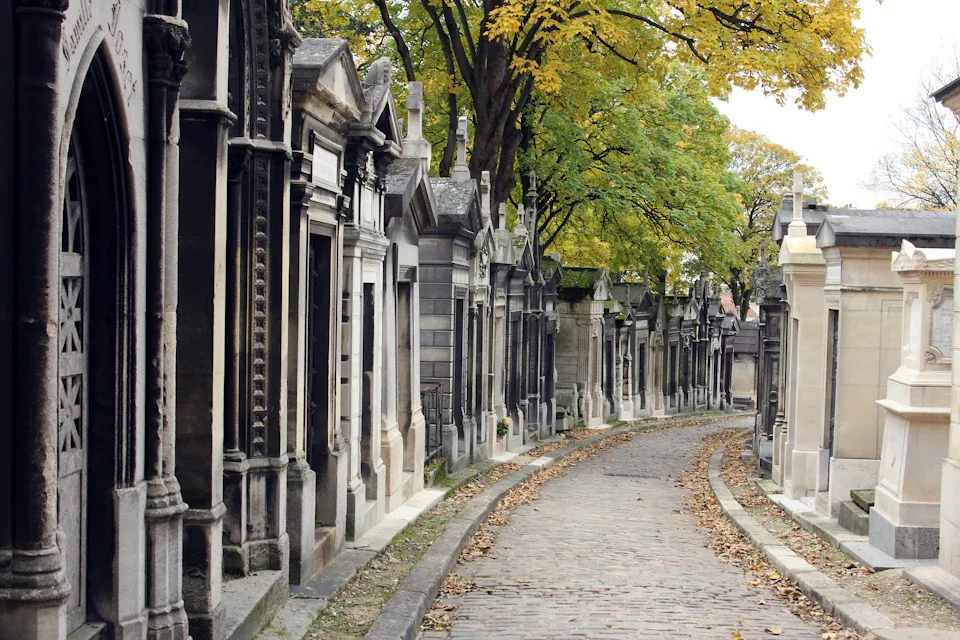
Père-Lachaise was created as a new kind of Paris cemetery: set away from the dense historic center, landscaped with trees, paths, slopes, and monuments rather than laid out as a simple burial ground. Its purpose was practical, but its design turned mourning into a public walk through architecture, sculpture, and memory.
The cemetery became important because Paris gradually placed major cultural and political figures here, making it feel less like a single monument and more like a map of French and international history.
Writers, musicians, artists, performers, and public figures share the same landscape with family tombs, chapels, and memorials, so the visit is as much about atmosphere as famous names.
For today’s visitor, the value is in the mix: quiet lanes, uneven stone paths, grand mausoleums, modest graves, and places tied to collective memory. It is not a museum with one fixed route; it rewards slow wandering, a few chosen graves, and enough time to let the setting explain why Père-Lachaise remains one of Paris’s most meaningful historic spaces.
♿ Accessibility & families
Accessibility & family policy
- Wheelchair users: Père-Lachaise is only partially accessible. Entry is free and step-free routes exist from the main gates, but this is a 43-hectare historic cemetery with steep gradients, cobblestones, uneven paving, narrow grave-side paths, and sections with steps. There are no elevators; the most comfortable wheelchair visit is a short, planned route on the wider avenues rather than a full cemetery circuit.
- Strollers: Strollers are allowed inside and do not need to be left at the entrance. Use a sturdy stroller rather than a lightweight travel buggy: many famous graves are reached by sloped lanes, rough surfaces, and tight side paths where you may need to park the stroller briefly and walk a few metres.
- Children and tickets: Admission is free for everyone, so there is no child ticket or free-entry age band to calculate. There is no attraction-style age limit, but children should stay with adults throughout the visit because Père-Lachaise is an active cemetery, not a playground or park.
- Reduced-mobility comfort notes: Plan for a quiet 1–2 hour visit, wear supportive shoes, and avoid trying to “see everything.” Benches and toilets are limited, queues are not the main issue, but distance, slopes, cobbles, and the lack of frequent rest points are. For families under 12, frame the visit as a calm outdoor walk and keep noise low around funerals and graves.
🏢 On-site amenities
On-site amenities
- Restrooms: There are public toilets inside Père-Lachaise, marked as “Toilettes” on the cemetery map. The site is open-air, so there is no floor level to navigate; facilities are at ground level and are free to use.
- Food and drink: There is no café, restaurant, or museum-style refreshment area inside the cemetery. Picnics and alcohol are not allowed. Bring a water bottle; drinking fountains are available in the grounds, but all fountains are shut during winter.
- Shop: There is no on-site gift shop. Maps are available free of charge, and any guidebooks, flowers, or souvenirs are found outside the cemetery, around the surrounding streets and metro exits.
- Wi-Fi and family facilities: Do not plan on site-wide visitor Wi-Fi; use mobile data or an offline map. There are no dedicated nursing rooms, baby-changing rooms, or prayer rooms inside the visitor route.
Reliability & freshness
FAQ
Do I need to book Père-Lachaise Cemetery in advance?
Yes for an Aksel Paris visit: reserve your slot even though entry to the cemetery itself is free.
What is the best time to visit Père-Lachaise Cemetery?
Go in the morning for a quieter walk and better energy for the slopes and uneven paths. The cemetery is open daily: 8:00–18:00 Monday–Friday, 8:30–18:00 Saturday, and 9:00–18:00 Sunday and public holidays.
How long should I plan for Père-Lachaise Cemetery?
Allow at least 1.5–2 hours for a first visit, and more if you want to find several famous graves without rushing. It is too large and hilly to treat as a quick 20-minute stop.
How do I get to Père-Lachaise Cemetery by metro?
Use Père Lachaise station on Metro lines 2 and 3, or Gambetta station on line 3 for an entrance near the upper side of the cemetery. The main address is 16 Rue du Repos, 75020 Paris.
Are there queues or difficult access at Père-Lachaise Cemetery?
There is no paid-entry queue like at a museum, but popular graves and narrow paths can get busy. Wear comfortable shoes: the site has cobblestones, slopes, stairs, and uneven ground.