Musée Rodin

Why visit

Who will love it
Best forPrioritize Musée Rodin if you like sculpture, quiet gardens, and museums where the building and setting matter as much as the masterpieces. It is especially rewarding in good weather, when the Hôtel Biron garden gives The Thinker, The Gates of Hell, and Rodin’s bronzes the space they need.
Who should skip it

You can lower its priority if you want a broad, fast-moving museum with many periods, big-name paintings, or a packed “must-see Paris” checklist. Come when you can give it a slow hour or two rather than treating it as a quick photo stop; for the right traveler, this is one of Paris’s most satisfying calm museum visits.

What to know beforehand

Editor’s note: Musée Rodin works best when treated as a slow sculpture visit, not a quick checklist stop. The garden is a major part of the experience, so the visit feels much stronger in dry weather; in rain, the Hôtel Biron still has the key works, but the rhythm becomes more compact and less atmospheric.

Good fit: travelers who enjoy sculpture, gardens, and quiet looking will get a lot from 1.5–2 hours here. Visitors expecting the scale and spectacle of the Louvre or Musée d’Orsay may find it modest, especially if they come only for The Thinker and leave without spending time on the bronze surfaces, fragments, and the way the works sit in the garden.

🎫 Tickets, tours & discounts

Which ticket to choose

For most visitors, the standard admission ticket is enough: it covers the Hôtel Biron galleries and the sculpture garden, including The Thinker and The Gates of Hell. Book it in advance for a smoother entry, especially on weekends and sunny days when the garden is the main draw.

Pay more only if the ticket adds something you will actually use: a guided visit, a private guide, or a combined ticket with another museum you already plan to visit. A “VIP” or fast-track label is not essential here in the same way it can be at the Louvre or Eiffel Tower.

  • Standard ticket: best for a relaxed first visit and independent museum-goers.
  • Guided ticket: best if you want context on Rodin’s technique, unfinished forms, casts, and relationships with other artists.
  • Combo ticket: best if Musée d’Orsay, Musée de l’Armée, or musée du Quai Branly - Jacques Chirac is already in your Paris plan.
  • Private tour: best for art-focused travelers or families who want a tighter, more personal route.
ImportantThe common first-time mistake is treating the museum as a quick stop for The Thinker. The stronger visit is to move between the garden and the Hôtel Biron rooms, where the textures, studies, hands, fragments, and plaster-to-bronze process make Rodin easier to understand.

Best time to go

Go in the morning if you want the calmest visit. The museum opens at 10:00, and the first part of the day is better for seeing the interiors without drifting through crowds around the most famous works.

Late afternoon is better for atmosphere and photos in the garden, especially in clear weather, but it is also when the outdoor sculptures attract more people. The museum is open Tuesday to Sunday, 10:00–18:30, with last entry at 17:45; Monday is the closed day.

For a solo visit, choose the morning and move slowly through the Hôtel Biron before the garden. For families, late morning works well because the route is compact and the garden gives children room to pause. For photographers, choose late afternoon for warmer light on the bronze, accepting that The Thinker area will be busier.

Combos and discounts

The most useful official combo choices are Musée Rodin with Musée d’Orsay, Musée Rodin with Musée de l’Armée, and Musée Rodin with musée du Quai Branly - Jacques Chirac. These make sense only if you genuinely want both museums; do not buy a combo just because the second attraction is famous.

Musée Rodin is included in the Paris Museum Pass, which can be good value if you are visiting several paid museums and monuments in a short stay. Free admission applies to under-18s, EU and EEA residents aged 18–25, and Paris Museum Pass holders; proof of eligibility is needed.

The permanent collections, garden, and exhibitions are also free on the first Sunday of each month from October to March.

TipIf you qualify for free entry, still plan your visit like a ticketed visitor. The saving is real, but sunny weekends and free-entry Sundays can make the garden feel much less quiet.

When a tour makes sense

A guided tour adds value if you want to understand why Rodin’s “unfinished” surfaces, repeated figures, fragments, and casts matter. A good guide also helps connect the garden sculptures with the indoor studies, so the museum feels less like a set of famous objects and more like a working artistic world.

Skip the tour if you mainly want a peaceful garden-and-gallery visit at your own pace. Musée Rodin is one of the easier major Paris museums to enjoy independently: allow about 1.5 to 2 hours, use the garden as a breather between rooms, and do not rush straight from The Thinker to the exit.

Weather now
Paris, France
NowMostly clear 🌤️
Temperature22°C
VisibilityExcellent
AerosolsClean air · AOD 0.14

Good conditions for visiting today.

AOD — how much dust and haze in the air dim the distant view. 0 clean, >0.4 noticeable, >0.7 heavy.

Crowd indicator

Mini-calculator based on crowd levels by day and time.

When to go?

Mini-calculator based on crowd levels by day and time.

Best time at Mon — 18:00

This day is usually calmer than average. This slot has a higher chance of a comfortable visit: compromise between light and visitor flow.

30–50% · Quiet60–80% · Moderate90–100% · Crowded

Nearest days

Today
10:0050%
12:0064%
14:0076%
16:0078%
17:0080%
18:0062%
Tomorrow
10:000%
12:000%
14:000%
16:000%
17:000%
18:000%
Day after tomorrow
10:0030%
12:0042%
14:0052%
16:0058%
17:0060%
18:0045%

How to find the entrance

1
Start on rue de VarenneGo to 77 rue de Varenne, 75007 Paris; Varenne metro on line 13 is the easiest approach.
2
Use the street entranceEnter from rue de Varenne, through the fenced Hôtel Biron grounds, not a mall or shopping passage.
3
Ticket and securityExpect ticket control and Vigipirate bag screening before the museum areas; allow a few extra minutes.
4
Travel lightSuitcases and large bags are not accepted; use the cloakroom by the Hôtel Biron collection entrance or lockers in the entrance hall.

Go to 77 rue de Varenne, 75007 Paris. The calmest metro approach is Varenne on line 13; Invalides also works with metro lines 8 and 13 or RER C. The museum is inside the Hôtel Biron estate, so look for the museum entrance on Rue de Varenne rather than a large palace-style front door.

The first point of friction is orientation: the site is split between the reception area, the Hôtel Biron collections, and the sculpture garden. Have your ticket ready for the entrance checkpoint; visitors using free admission should have their proof ready there too.

  • Extra time can be lost at the entrance checkpoint and ticket desk.
  • The garden draws the biggest crowd in good weather, especially around The Thinker and The Gates of Hell.
  • A free cloakroom is available for coats, large umbrellas, backpacks, and small luggage, but not large suitcases or valuables.

If you need step-free access, use the accessible entrance at 79 rue de Varenne. From there, the reception hall, garden paths, and museum collection route are set up for accessible movement, with ramps and an interior lift.

Practical limits & what to bring

What to consider before your visit

Musée Rodin is calmer than the Louvre or Orsay, but entry still involves ticket control and a Vigipirate security check at 77 rue de Varenne. Build in a few extra minutes, especially in good weather, when many visitors head straight for the sculpture garden.

The visit involves a mix of indoor rooms, garden paths and standing time around the major works. There is no special dress code, but visitors must be properly dressed: no bare feet, no undressed or indecent outfits.

The site is accessible, with lift access to the permanent collection; only umbrella-type strollers are allowed inside, and larger strollers can be refused or sent to storage during busy periods.

What you can and cannot bring

  • Suitcases of any size are not allowed on site.
  • Large bags and bulky luggage are not allowed.
  • Small backpacks are allowed, subject to security inspection.
  • Large umbrellas, backpacks and small deposited items go to the cloakroom, not into the galleries.
  • Valuables such as cameras, money and identity documents should stay with you; the cloakroom does not accept them.
  • Weapons, ammunition, explosive, flammable or volatile substances, drugs, heavy or smelly objects, artworks and antiques are forbidden.
  • Animals are not allowed, except guide dogs and assistance dogs.
  • Photography is allowed without flash, tripod or selfie stick.
  • Eating, drinking and smoking are forbidden inside the public indoor areas.
  • Light picnics are allowed only for individual visitors on outdoor benches; alcohol is forbidden.
  • Do not touch the works, climb on sculpture bases, enter flowerbeds or water features, or walk on lawns outside marked areas.
ВажноDo not arrive with a suitcase after hotel checkout. The museum is not a luggage-storage stop, even if your bag looks cabin-size.

Storage and belongings

The free cloakroom is in the Hôtel Biron, at the entrance to the permanent collections; lockers are in the entrance-hall area on level -1. Use them for coats, large umbrellas and small accepted items, but keep valuables, documents and money with you.

Only umbrella strollers are accepted inside the museum. Full-size strollers may need to be left at the cloakroom if they create circulation problems, so a compact foldable stroller is the safest choice for families.

💡 Useful tips

  • The original 18th-century parquet floors inside the Hôtel Biron creak noticeably underfoot, making soft-soled shoes the best choice for a quiet and comfortable visit.
  • For a striking photograph of "The Thinker" with the golden dome of Les Invalides in the background, position yourself slightly to the right of the bronze and shoot upward from a low angle.
  • Do not skip the glass-walled Galerie des Marbres tucked away in the garden, as it is the best place to closely examine Rodin's unfinished marble blocks and raw chisel marks.
  • Walk to the very back of the estate to find the Bassin d'Ugolin, where the harrowing sculpture of Ugolino and his children is dramatically positioned directly in the center of the pond.
  • The bright white gravel paths in the formal garden reflect intense sunlight during clear afternoons, making sunglasses essential for comfortably viewing the outdoor bronzes.
  • Look closely at the hands and feet of the "Burghers of Calais" group in the garden; Rodin intentionally oversized them to emphasize the physical and emotional weight of the figures.
  • If you want a break without leaving the museum atmosphere, look for the L'Augustine café hidden within the garden, which offers outdoor seating surrounded by the estate's greenery.

Location and what's nearby

Что за район

  • Это спокойная часть 7-го округа: министерства, посольства, особняки и широкие улицы вместо плотной туристической суеты.
  • Район хорошо подходит для неспешного музейного дня: скульптура, военная история, классические сады и короткие переходы между остановками.
  • Атмосфера здесь взрослая и сдержанная: меньше ночной жизни, больше галерей, кафе для обеда и прогулок у Invalides.
  • Семьям удобно за счёт садов и открытых пространств, но район не про спонтанный шопинг и шумные развлечения.

Рядом пешком (до 15 минут)

  • Hôtel des Invalides — монументальный комплекс с куполом Наполеона · 7 мин
  • Musée de l’Armée — оружие, доспехи и военная история Франции · 8 мин
  • Dôme des Invalides — эффектная церковь с гробницей Наполеона · 8 мин
  • Esplanade des Invalides — широкий зелёный променад для паузы · 9 мин
  • Musée Maillol — камерные выставки и скульптурная линия района · 10 мин
  • Le Bon Marché — исторический универмаг с сильным food hall · 13 мин
  • La Grande Épicerie de Paris — гастрономические покупки и съедобные сувениры · 14 мин
  • Assemblée nationale — фасад французского парламента у Сены · 15 мин

В 15–30 минут на транспорте

  • Musée d’Orsay — логичное продолжение дня после скульптуры · 15 мин
  • Tour Eiffel — классическая связка с 7-м округом · 15 мин
  • Saint-Germain-des-Prés — галереи, книжные магазины и кафе · 15 мин
  • Place de la Concorde — мост к Тюильри и правому берегу · 15 мин
  • Musée du Louvre — большой музейный финал после камерного Rodin · 20 мин

Где поесть рядом

  • Arpège — высокая кухня Alain Passard и овощные меню · дорого · бронь обязательна · 7 мин пешком
  • Auguste — гастрономическая французская кухня рядом с музеем · дорого · бронь обязательна · 4 мин пешком
  • Café des Ministères — современное бистро с парижской классикой · выше среднего · желательно забронировать · 12 мин пешком
  • Coutume Café — кофе, бранч и лёгкий дневной перерыв · средний · можно без брони · 9 мин пешком
  • Brasserie Thoumieux — нарядная брассери на Rue Saint-Dominique · выше среднего · желательно забронировать · 14 мин пешком

Готовый маршрут на день

Начните с Musée Rodin, затем пройдите к Hôtel des Invalides и Dôme des Invalides, чтобы продолжить тему монументальной французской истории. На обед удобно зайти в Café des Ministères, после чего можно дойти до Le Bon Marché и La Grande Épicerie de Paris. Если хочется продлить день, завершайте его у Musée d’Orsay или на Saint-Germain-des-Prés.

На заметкуНе перегружайте этот маршрут Лувром и Эйфелевой башней одновременно — из Rodin лучше выбрать один крупный финальный акцент.
Reference

Facts

Read more

Цифры и масштаб

  • Сад: 3 гектара классифицированной территории — редкий для центра Парижа музей, где часть главного маршрута проходит под открытым небом.
  • Залы: 18 комнат Hôtel Biron — экспозиция читается как камерный маршрут, а не как большой энциклопедический музей.
  • Открытие: 4 августа 1919 — музей появился после дара Родена французскому государству.
  • Hôtel Biron: построен в 1732 году по проекту Жана Обера — скульптуры стоят в особняке XVIII века, а не в нейтральном «белом кубе».
  • «Врата ада»: 635 × 400 × 85 см и более 200 фигур — это не просто дверь, а целая скульптурная система.
  • «Мыслитель»: 189 × 98 × 140 см — садовая версия намного крупнее первоначальной фигуры около 70 см.
  • Архив: более 60 000 документов — музей важен не только скульптурами, но и материалами о мастерской, заказах и окружении Родена.

Мифы и заблуждения

  • Миф: «Мыслитель» всегда был самостоятельной статуей. На самом деле: он появился как фигура Данте для «Врат ада».
  • Миф: у «Мыслителя» кулак прижат ко лбу. На самом деле: в канонической позе рука подпирает подбородок, а не лоб.
  • Миф: Hôtel Biron был парижским домом детства Родена. На самом деле: Роден арендовал здесь мастерскую с 1908 года; его дом был в Мёдоне.
  • Миф: «Врата ада» были установлены в заказанном музее. На самом деле: музей декоративных искусств не построили, а бронзовый отлив появился после смерти Родена.
  • Миф: «Поцелуй» остался частью «Врат ада». На самом деле: Роден вывел группу из композиции и сделал самостоятельным произведением.

Редкое и необычное

  • Роден начал в Hôtel Biron с четырёх комнат на первом этаже, а с 1911 года занял всё здание.
  • Рильке, личный секретарь Родена, первым привёл его к Hôtel Biron; в письме он описывал заброшенный сад с кроликами.
  • В архиве есть газетные вырезки, которые секретари Родена сортировали по тону, включая ярлыки «хвалебно» и «восторженно».
  • «Я прекрасна» собрана из двух прежних фигур — «Скорчившейся женщины» и «Падающего человека», что показывает метод Родена как монтаж.
  • «Внутренний голос» лишился рук и части ног для проекта памятника Виктору Гюго, но Роден затем выставлял фигуру именно в этом состоянии.
  • Мраморную «Данаиду» резал Жан Эскула: в зале виден не только замысел Родена, но и работа его практиков.
Background

History

Read more

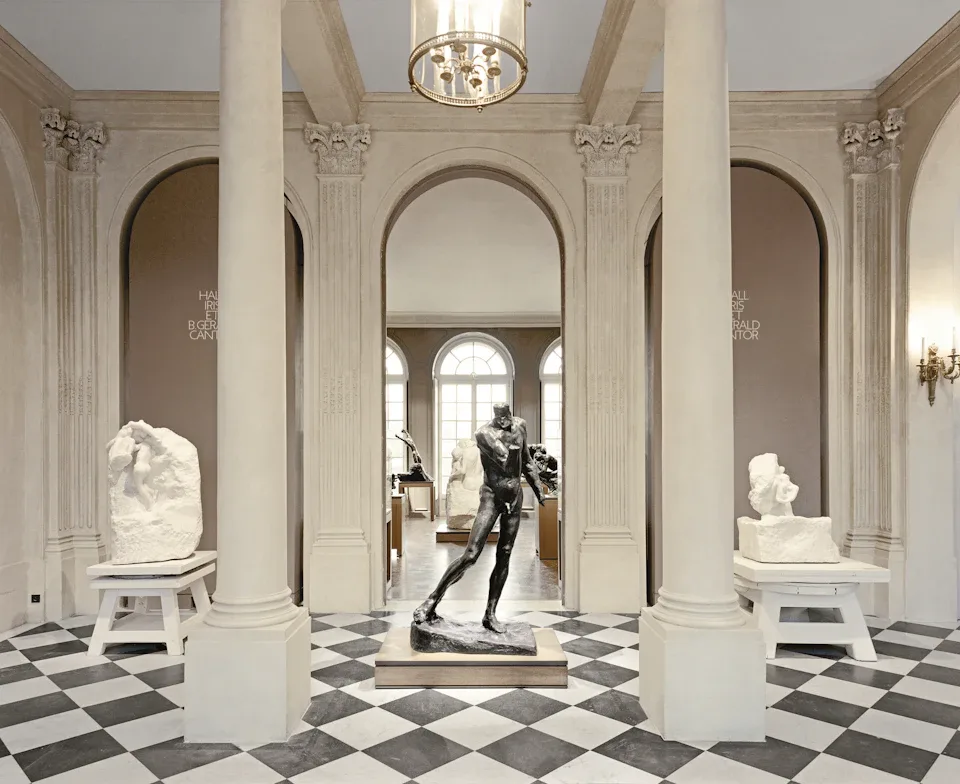
Musée Rodin exists because Rodin’s work was tied closely to this house and garden, not just to a gallery wall. The Hôtel Biron became his Paris workspace, and the museum preserves that connection: sculpture, architecture, and open air are part of the same visit.

Why it matters now

This is one of the best places in Paris to understand Rodin physically. Works such as The Thinker and The Gates of Hell are not only famous images; here you can see their scale, surfaces, rough edges, and unfinished energy up close.

The garden is not a decorative extra. It changes how the bronzes read, giving them distance, shadow, and movement that a closed room cannot offer. That is why the museum suits visitors who want a slower, more focused experience than the city’s larger art museums.

♿ Accessibility & families

Accessibility & family policy

  • Wheelchair access: Musée Rodin Paris is accessible from the entrance at 79 rue de Varenne through the reception hall, temporary exhibition space, Hôtel Biron collections, Sculpture Garden, café and auditorium. The museum has access ramps, adapted garden paths, an interior lift serving the full collection route, accessible toilets in the entrance hall, garden and museum, and loan wheelchairs in the reception hall and museum.
  • Strollers: Strollers are allowed, but only lightweight cane/umbrella-style strollers are permitted inside the museum. Access is practical with ramps and lifts, and there is a baby-changing area in the toilets on level -1 of the entrance hall. Scooters and bicycles are not allowed inside.
  • Children and tickets: Admission is free for visitors under 18 with valid photo ID. It is also free for EU/EEA residents aged 18–25, and for disabled visitors with one accompanying guest/helper. The children’s audioguide costs €6.50.
  • Comfort notes: This is a good museum for families because the Sculpture Garden gives children space to reset between indoor rooms. For reduced-mobility visitors, the main constraint is crowding rather than stairs; group visits inside the museum and temporary exhibitions are limited to five wheelchair users per group, while the garden can accommodate more.

🏢 On-site amenities

On-site amenities

  • Restrooms: Free toilets are available on level -1 of the entrance hall and in the sculpture garden. An accessible toilet on the first floor of the permanent collection is reserved for disabled visitors.
  • Café: L’Augustine is the museum café-restaurant in the sculpture garden, with a terrace and a relaxed, polished lunch-and-break feel rather than a formal fine-dining setup. Access is inside the paid museum area.
  • Gift shop: The museum shop sells Rodin-related souvenirs, sculpture reproductions, books, textiles, jewelry, and design gifts.
  • Wi-Fi: Free Wi-Fi is available on the museum grounds; connect to Musée_Rodin_Wifi.
  • Water and food: Bring a small water bottle for the garden, but do not eat or drink inside the museum rooms. Light picnics are allowed for individual visitors only on outdoor benches; alcohol is not allowed.
  • Families: Baby-changing facilities are in the toilets on level -1 of the entrance hall. Only umbrella-type strollers are allowed inside the museum.

Reliability & freshness

AuthorAksel Paris Team
PublishedApril 26, 2026
UpdatedApril 26, 2026

Related attractions

FAQ

Do I need to book Musée Rodin tickets in advance?

Yes, book a timed ticket; standard admission is €14, with combined museum tickets available from €23–€26 depending on the pairing.

What is the best time to visit Musée Rodin?

Go at opening time, 10:00, for the calmest experience inside Hôtel Biron and around the garden sculptures. In good weather, the garden is the highlight but also the busiest part.

How long should I plan for Musée Rodin?

Allow 1.5 to 2 hours for the mansion, The Thinker, The Gates of Hell, and an unhurried walk through the sculpture garden.

How do I get to Musée Rodin by metro?

The museum is at 77 rue de Varenne, 75007 Paris. The nearest metro stops are Varenne on line 13 and Invalides on lines 8 and 13, with RER C also at Invalides.

Are queues a big issue at Musée Rodin?

It is more manageable than Paris’s largest museums, but a booked ticket helps avoid the ticket-desk line. Security screening still applies, and large bags or suitcases are not allowed.