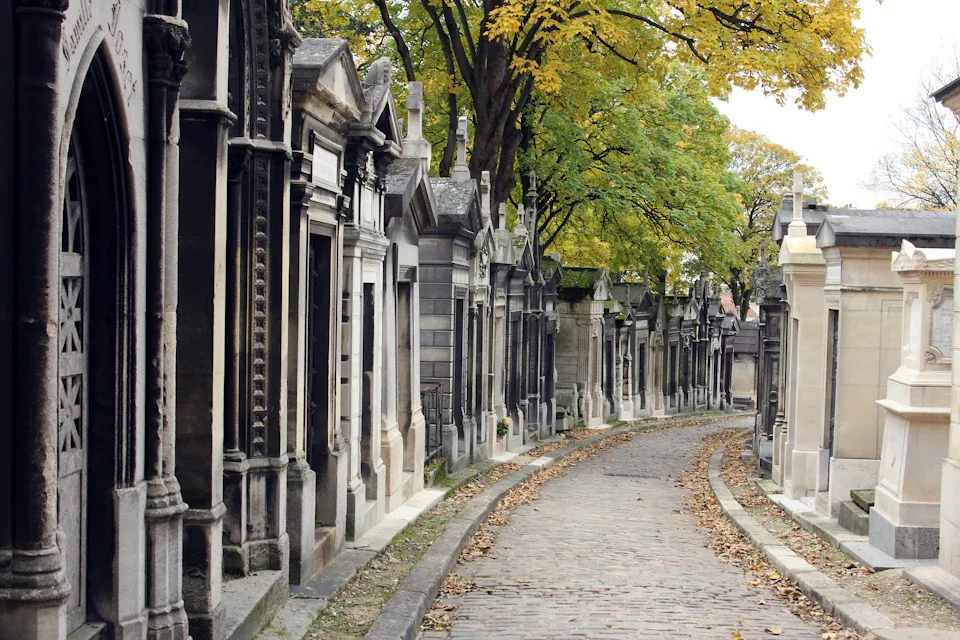
Prioritize Père-Lachaise if you want a quiet, self-guided Paris walk with real historical weight rather than a conventional museum visit. It is especially rewarding for travelers interested in literature, music, sculpture, funerary art, and famous graves, with free entry and a large landscape of avenues, tombs, and memorials in the 20th arrondissement.
Pourquoi visiter
Skip it or lower its priority if you have limited time, poor mobility, or little interest in wandering through a cemetery setting: the site is extensive, uneven, and not suited to a rushed stop. Practical verdict: go when you can give it unhurried time, wear comfortable shoes, and treat it as a reflective walk rather than a checklist attraction.
Ce qu'il faut savoir avant
Editor’s note: Père-Lachaise works best when treated as a long, quiet walk rather than a quick “famous graves” stop. The site is large, hilly in places, and easier to enjoy with comfortable shoes, a simple route, and enough time to wander without turning the visit into a navigation exercise.
🎫 Billets, visites et réductions
Visite audioguidée sur smartphone (Smartphone Audio Guide Tour)
- Application mobile téléchargeable
- Itinéraire GPS couvrant les 43 hectares
- Commentaires audio sur les tombes célèbres
- Accès libre au cimetière inclus
Visite guidée en petit groupe (Small Group Guided Tour)
- Visite à pied de 2 heures
- Guide conférencier professionnel
- Groupe limité à 20 personnes maximum
- Anecdotes historiques et culturelles
Visite guidée privée (Private Guided Tour)
- Guide privé exclusif pour votre groupe
- Durée de 2 à 3 heures
- Itinéraire personnalisé selon vos intérêts
- Flexibilité totale de l'heure de départ
Quel billet choisir
L'entrée au cimetière du Père-Lachaise est totalement gratuite pour tous les visiteurs. Il n'y a pas de billet d'entrée classique à acheter pour franchir les grilles.
Cependant, pour donner du sens à cette vaste nécropole de 44 hectares, l'option payante (à partir de 7 EUR) concerne les audioguides, les applications de visite sur smartphone ou les visites guidées, qui nécessitent une réservation préalable en ligne.
Payer pour un support de visite prend tout son sens ici : le cimetière est un véritable labyrinthe pavé et vallonné. Sans aide, trouver une sépulture précise relève du défi.
- Entrée libre : Accès gratuit au site, idéal pour une flânerie spontanée (téléchargez un plan au préalable).
- Audioguide / Application (dès 7 EUR) : Réservation requise, parfait pour repérer facilement les tombes célèbres (Jim Morrison, Édith Piaf, Oscar Wilde) à son propre rythme.
- Visite guidée : Le choix premium pour découvrir l'histoire de l'art funéraire, les symboles cachés et les anecdotes historiques.
Important : L'erreur classique lors d'une première visite est de venir les mains dans les poches. Sans plan ni guide numérique, vous risquez de marcher pendant des heures en tournant en rond dans les divisions sans trouver les sépultures que vous cherchez.
Quand visiter
Pour éviter la foule autour des tombes les plus célèbres, privilégiez une visite dès l'ouverture, vers 8h00 en semaine ou 9h00 le week-end. L'atmosphère matinale, souvent nimbée de brume, renforce le caractère romantique et paisible du lieu. C'est le moment parfait pour les voyageurs en solo et les photographes.
L'après-midi, particulièrement le week-end, les allées principales deviennent très fréquentées. La fin de journée offre une belle lumière dorée à travers les arbres centenaires, mais attention à l'heure : les gardiens commencent à faire évacuer les lieux vers 17h30.
Conseil : Arrivez par la station de métro Gambetta (ligne 3). Vous commencerez votre visite par le haut de la colline et descendrez doucement vers l'entrée principale (métro Philippe Auguste ou Père Lachaise). C'est beaucoup moins fatigant pour les jambes.
Combos et réductions
Puisque l'accès au cimetière est gratuit, les réductions s'appliquent uniquement aux visites guidées et aux applications audio. Les enfants et les adolescents bénéficient généralement de la gratuité ou de tarifs très réduits sur les visites guidées officielles.
Il n'existe pas de billets combinés classiques avec d'autres monuments parisiens pour l'entrée. Toutefois, certaines plateformes de réservation proposent des forfaits incluant une visite guidée du Père-Lachaise couplée à une exploration du quartier de Montmartre ou des Catacombes sur la même journée.
Les détenteurs de pass touristiques (comme le Paris Pass) n'ont pas de coupe-file ici, mais peuvent parfois obtenir une visite guidée à pied incluse dans leur forfait.
Quand opter pour une visite guidée
Une visite guidée par un conférencier transforme totalement l'expérience. Au lieu de simplement chercher des noms sur des pierres, vous découvrez les anecdotes historiques, la signification des symboles maçonniques ou romantiques cachés sur les caveaux, et l'histoire poignante du Mur des Fédérés.
C'est un investissement très pertinent pour les passionnés d'histoire, de littérature ou d'art funéraire. Le guide sait exactement comment relier les tombes de Chopin, Balzac et Molière par les chemins de traverse les plus charmants, optimisant ainsi votre temps et votre énergie.
En revanche, si vous préférez flâner dans le silence, en vous concentrant sur la photographie ou la lecture, une visite libre avec un bon plan numérique sera amplement suffisante.
Индикатор загруженности
Afternoons and weekends draw the largest crowds to the main avenues, while early weekday mornings offer the most peaceful atmosphere.
Мини-калькулятор на основе загруженности по дням и времени.
День обычно спокойнее среднего. В этот слот шанс пройти комфортнее выше: Closed to the public. Погода сейчас неидеальна: overcast ☁️.
Ближайшие дни
Comment trouver l'entrée
Use the main cemetery address: 8 Boulevard de Ménilmontant, 75020 Paris. For the simplest arrival, use Philippe Auguste metro station on Line 2; it is closest to the main gate. Père Lachaise station on Lines 2 and 3 is also nearby, but it brings you toward a side approach, which can feel confusing on a first visit.
There is no paid entrance desk for an independent visit: entry to the cemetery itself is free. If you booked a tour or audio product, that booking is for the guiding service, not for a special gate or fast-track cemetery access.
The main delay is not check-in or security; it is orientation once you are inside. The site is large, sloped in places, and paved with uneven paths, so expect to lose time finding specific graves and moving between sections.
Restrictions pratiques et quoi emporter
What to consider before visiting
Père-Lachaise is an active cemetery, not a conventional museum. There is no formal dress code, but dress and behave respectfully: keep voices low, do not sit or climb on tombs, and give space to families attending funerals or visiting graves.
The site is large — about 43 hectares — with long avenues, cobbled or uneven paths, slopes, and some entrances that involve stairs. Comfortable shoes matter more than smart clothing. Allow at least 2 hours if you want more than a quick look at one or two famous graves.
There are no age limits. Strollers can be used, but routes are not equally smooth: for an easier first visit, use the main entrance by Boulevard de Ménilmontant near Philippe Auguste metro, line 2, or plan a downhill route from Gambetta.
What you can and cannot bring
- Alcohol is not allowed.
- Picnics are not allowed.
- Sound equipment and musical instruments are not allowed without special authorisation.
- Animals are not allowed, even on a leash.
- Bicycles, scooters and similar wheeled vehicles are not allowed, even if pushed by hand.
- Jogging, fitness and other sports are not allowed.
- Treasure hunts, escape-game-style visits and organised games are not allowed.
- Feeding animals is not allowed.
- A water bottle is fine and useful.
- A small day bag is practical for water, a phone battery, a paper map and weather layers.
- Personal photography is acceptable when done discreetly and without disturbing mourners or ceremonies.
Storage and belongings
There is no museum-style cloakroom or locker system at Père-Lachaise, so arrive with only what you are ready to carry. Large suitcases are a poor fit for the site: the paths are uneven, distances are long, and there is no convenient place to leave luggage at the gates.
Strollers can come in, but they are easier on the broader avenues than on narrow, sloped or older sections. For luggage, use your hotel, apartment host or a city luggage-storage service elsewhere in Paris before going to the cemetery.
💡 Conseils utiles
- The cobblestones in the older sections, particularly along the steep descent from the Gambetta entrance, become extremely slippery after rain and require high-traction soles.
- GPS signals frequently bounce under the dense tree canopy, making phone navigation unreliable, so take a high-resolution photo of the large physical map displayed at the main gate before walking inward.
- While crowds gather around Chopin's resting place in Division 11, most completely miss the nearby tomb of Alexandre-Théodore Brongniart, the architect who actually designed the cemetery's original layout.
- The only way to photograph Jim Morrison's grave in Division 6 without a crowd of onlookers is to arrive exactly at the weekday opening time, well before the first guided tours reach that sector around 9:30 AM.
- If you walk near the quieter eastern walls around Divisions 87 through 94 during the last hour before closing, you have a high chance of spotting the cemetery's resident foxes and semi-wild cats.
- Do not rely solely on the division numbers carved into the stone corner markers at intersections, as weathering has made many of the 19th-century numerals entirely illegible.
- Fans of early cinema should seek out the often-missed grave of Georges Méliès in Division 64, where visitors maintain a quiet tradition of leaving small vintage cinema tickets on the bust.
Localisation et environs
What kind of area
- Père-Lachaise sits between the 20th and the eastern edge of the 11th arrondissement: residential, hilly, and less polished than central Paris.
- The day suits walkers who like history, street corners, small bistros, and quiet gardens more than luxury shopping or monument-hopping.
- The cemetery is large and uneven, so the surrounding plan should stay compact: one cultural stop, one neighborhood walk, and a meal.
- Ménilmontant, Charonne, and Belleville add a local Paris feel nearby, with studios, bars, bakeries, and small restaurants.
Nearby on foot (within 15 minutes)
- Square Samuel de Champlain — small garden with Père-Lachaise wall memorials · 3 min
- Jardin Naturel Pierre-Emmanuel — wild-feeling pocket garden beside cemetery walls · 6 min
- Passage de la Folie-Regnault — quiet cobbled lane of old workshops · 8 min
- Square de la Roquette — local pause after the cemetery’s steeper paths · 10 min
- Atelier des Lumières — immersive digital art in a former foundry · 15 min
- Église Notre-Dame-de-la-Croix de Ménilmontant — grand 19th-century church above Ménilmontant · 15 min
- Pavillon Carré de Baudouin — free neighborhood art center in Ménilmontant · 15 min
- La Campagne à Paris — village-like hilltop streets with small houses · 15 min
15-30 minutes by transport
- Place de la Bastille — easy next stop for Marais or canal plans · 15 min by metro
- Place des Vosges — elegant arcaded square for a calmer Marais finish · 20 min by metro
- Canal Saint-Martin — waterside cafes and bridges after a cemetery walk · 20 min by metro
- Parc de Belleville — open city views and a steeper local neighborhood · 20 min by taxi
- Musée Carnavalet — Paris history that pairs well with famous graves · 25 min by metro
Where to eat nearby
- Septime — modern tasting-menu landmark on Rue de Charonne · expensive · reservation essential · 8 min by taxi
- Le Baratin — Belleville bistro and natural-wine cellar · above average · booking recommended · 8 min by taxi
- Cachette — polished small-plate cooking near Gambetta · above average · booking recommended · 8 min walk
- Le Piston Pélican — neighborhood bistro-bar by Rue de Bagnolet · mid-range · walk-ins possible · 8 min walk
Ready-made day route
Start with Cimetière du Père-Lachaise while you still have energy for its slopes, then step out toward Jardin Naturel Pierre-Emmanuel and La Campagne à Paris for a softer residential contrast. Continue to Pavillon Carré de Baudouin or Atelier des Lumières, then finish with dinner at Le Baratin if you want a classic eastern-Paris bistro evening.
СправочноFaits
Читать
Chiffres et échelle
- Superficie : 44 hectares, ce qui en fait le plus grand espace vert situé à l'intérieur de Paris.
- Ouverture : 21 mai 1804, date à laquelle le site a accueilli sa toute première sépulture sous l'impulsion de Napoléon Ier.
- Nombre de sépultures : 70 000 concessions funéraires actives, abritant les dépouilles de personnalités du monde entier.
- Fréquentation : 3,5 millions de visiteurs annuels, un chiffre qui place le site parmi les monuments les plus fréquentés de France.
- Patrimoine arboré : 4 000 arbres de 80 espèces différentes, constituant un réservoir de biodiversité majeur pour la capitale.
- Divisions : 97 secteurs numérotés permettant de s'orienter dans ce labyrinthe de chemins escarpés et de collines.
- Localisation : 16 Rue du Repos, accessible via les stations de métro Père Lachaise sur les lignes 2 et 3.
Mythes et réalités
- Mythe : Le cimetière a connu un succès immédiat auprès des Parisiens dès 1804. En réalité : Jugé trop excentré, il ne comptait que 13 tombes la première année avant une campagne de marketing historique.
- Mythe : C'est le plus ancien cimetière encore en activité dans la ville. En réalité : Le cimetière du Calvaire à Montmartre est bien plus ancien, sa création remontant à l'année 1688.
- Mythe : Toute personne disposant de moyens financiers peut y acheter une concession. En réalité : L'inhumation est strictement réservée aux résidents parisiens ou aux personnes décédées dans la capitale française.
Détails rares et insolites
- Le gisant de Victor Noir est célèbre pour sa section proéminente, polie par les mains des visiteurs espérant retrouver fertilité ou virilité.
- Le Mur des Fédérés porte encore les impacts de balles de l'exécution des derniers combattants de la Commune de Paris en 1871.
- Des ruches sont installées dans les secteurs les plus calmes, produisant un miel local dont la vente soutient la biodiversité du parc.
- La sépulture d'Oscar Wilde est protégée par une paroi de verre depuis 2011 pour empêcher la dégradation de la pierre par des milliers de baisers.
- Les amants légendaires Héloïse et Abélard occupent la plus ancienne sépulture du site, leurs restes ayant été transférés ici pour accroître le prestige du lieu.
- Le cimetière sert de refuge à une faune variée, incluant des renards et de nombreuses espèces d'oiseaux rares qui nichent dans les cryptes anciennes.
КонтекстHistoire
Читать
Ouvert en 1804 sous l'impulsion de Napoléon, le cimetière du Père-Lachaise n'a pas toujours suscité l'engouement. À ses débuts, les Parisiens refusaient d'y être enterrés, jugeant ce nouveau lieu de repos trop éloigné du centre-ville et dénué de tout prestige.
Pour inverser la tendance, les autorités orchestrent alors un véritable coup de maître : le transfert des dépouilles de Molière, de Jean de La Fontaine et des célèbres amants Abélard et Héloïse. Cette stratégie de communication fonctionne à merveille.
L'élite parisienne se dispute soudainement les concessions, transformant rapidement le site en un prestigieux panthéon à ciel ouvert.
Un jardin romantique chargé d'histoire
Aujourd'hui, le Père-Lachaise s'étend sur 44 hectares et reste le plus grand cimetière intra-muros de la capitale. Conçu comme un vaste jardin à l'anglaise, il offre une promenade paisible à travers des allées sinueuses, pavées et souvent vallonnées.
Les visiteurs du monde entier viennent s'y perdre pour admirer l'architecture spectaculaire des caveaux familiaux et chercher les sépultures de figures légendaires telles qu'Édith Piaf, Oscar Wilde, Frédéric Chopin ou Jim Morrison.
♿ Доступность и семьи
Accessibility & family policy
- Wheelchair users: Père-Lachaise is only partially accessible. Entry is free and step-free routes exist from the main gates, but this is a 43-hectare historic cemetery with steep gradients, cobblestones, uneven paving, narrow grave-side paths, and sections with steps. There are no elevators; the most comfortable wheelchair visit is a short, planned route on the wider avenues rather than a full cemetery circuit.
- Strollers: Strollers are allowed inside and do not need to be left at the entrance. Use a sturdy stroller rather than a lightweight travel buggy: many famous graves are reached by sloped lanes, rough surfaces, and tight side paths where you may need to park the stroller briefly and walk a few metres.
- Children and tickets: Admission is free for everyone, so there is no child ticket or free-entry age band to calculate. There is no attraction-style age limit, but children should stay with adults throughout the visit because Père-Lachaise is an active cemetery, not a playground or park.
- Reduced-mobility comfort notes: Plan for a quiet 1–2 hour visit, wear supportive shoes, and avoid trying to “see everything.” Benches and toilets are limited, queues are not the main issue, but distance, slopes, cobbles, and the lack of frequent rest points are. For families under 12, frame the visit as a calm outdoor walk and keep noise low around funerals and graves.
🏢 Что есть на площадке
On-site amenities
- Restrooms: There are public toilets inside Père-Lachaise, marked as “Toilettes” on the cemetery map. The site is open-air, so there is no floor level to navigate; facilities are at ground level and are free to use.
- Food and drink: There is no café, restaurant, or museum-style refreshment area inside the cemetery. Picnics and alcohol are not allowed. Bring a water bottle; drinking fountains are available in the grounds, but all fountains are shut during winter.
- Shop: There is no on-site gift shop. Maps are available free of charge, and any guidebooks, flowers, or souvenirs are found outside the cemetery, around the surrounding streets and metro exits.
- Wi-Fi and family facilities: Do not plan on site-wide visitor Wi-Fi; use mobile data or an offline map. There are no dedicated nursing rooms, baby-changing rooms, or prayer rooms inside the visitor route.
Fiabilité et fraîcheur
FAQ
Do I need to book Père-Lachaise Cemetery in advance?
Yes for an Aksel Paris visit: reserve your slot even though entry to the cemetery itself is free.
What is the best time to visit Père-Lachaise Cemetery?
Go in the morning for a quieter walk and better energy for the slopes and uneven paths. The cemetery is open daily: 8:00–18:00 Monday–Friday, 8:30–18:00 Saturday, and 9:00–18:00 Sunday and public holidays.
How long should I plan for Père-Lachaise Cemetery?
Allow at least 1.5–2 hours for a first visit, and more if you want to find several famous graves without rushing. It is too large and hilly to treat as a quick 20-minute stop.
How do I get to Père-Lachaise Cemetery by metro?
Use Père Lachaise station on Metro lines 2 and 3, or Gambetta station on line 3 for an entrance near the upper side of the cemetery. The main address is 16 Rue du Repos, 75020 Paris.
Are there queues or difficult access at Père-Lachaise Cemetery?
There is no paid-entry queue like at a museum, but popular graves and narrow paths can get busy. Wear comfortable shoes: the site has cobblestones, slopes, stairs, and uneven ground.