Palais Garnier
Why visit
You may lower its priority if you dislike paid self-guided interiors, crowded rooms, or ornate historic decoration that demands patience rather than spectacle. Book ahead, go without rushing, and treat it as a focused architecture visit rather than a casual lobby peek.
What to know beforehand
It tends to reward architecture lovers, ballet and theatre fans, first-time visitors who want “grand Paris,” and travelers who enjoy looking closely at decorative detail.
Visitors who dislike crowds, expect a full backstage experience, or only want a free lobby peek may find the visit expensive for what it is; in that case, a guided or after-closing tour is the stronger choice.
🎫 Tickets, tours & discounts
Самостоятельный входной билет (Self-Guided Admission Ticket)
- доступ в общественные зоны Palais Garnier
- парадная лестница и Grand Foyer
- салоны, галереи и ротонды по маршруту посещения
- временные выставки при наличии в день визита
Самостоятельный билет с аудиогидом (Self-Guided Tour with Audio Guide)
- вход в общественные пространства оперы
- аудиокомментарий для самостоятельного маршрута
- Grand Staircase, Grand Foyer и музейные зоны
- осмотр в своем темпе обычно 60–90 минут
Экскурсия с гидом по Palais Garnier (Guided Tour)
- групповая экскурсия примерно на 90 минут
- комментарии гида об архитектуре и истории оперы
- парадная лестница, фойе и салоны по маршруту
- доступ в зрительный зал при отсутствии репетиций или мероприятий
Вечерняя экскурсия после закрытия (After-Hours Guided Tour)
- посещение после закрытия для дневных посетителей
- гид рассказывает о театральной истории и легендах здания
- маршрут по парадным фойе, лестницам и залам
- меньше пересечений с обычным дневным потоком
Which ticket to choose
For most first-time visitors, the self-guided visit is enough. It gives you the core Palais Garnier experience: the Grand Staircase, Grand Foyer, salons, rotundas, the Opera Library-Museum, and temporary exhibitions when accessible. Allow about 1 hour 30 minutes; this is not a quick lobby stop.
Pay more only if you want context, not just photos. A guided tour is worth it for architecture lovers, ballet and opera fans, or anyone who wants the stories behind Charles Garnier’s design, the auditorium, the chandelier, the Chagall ceiling, and the theatre’s working life.
- Self-guided ticket: best value if you like moving at your own pace.
- Multimedia tablet: useful if you want explanations without joining a group; adult tablet is €8 on site or €7 when bought online.
- Guided tour: better for history, symbolism, theatre traditions, and hidden details.
- After-hours guided tour: the most atmospheric option, but more expensive and still dependent on the building’s theatre schedule.
When to go
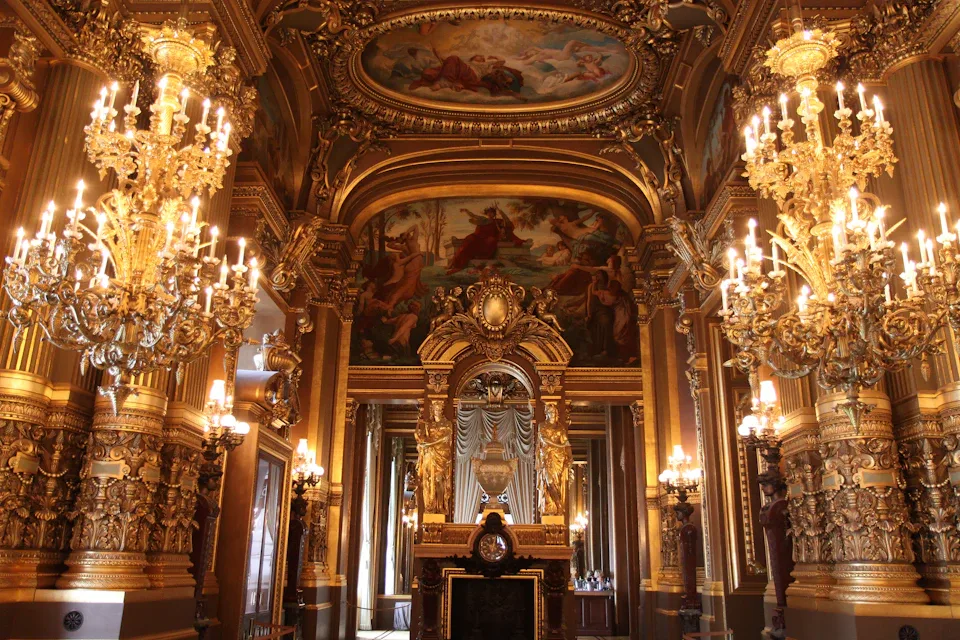
The best balance is a morning slot, close to opening. The Grand Staircase and Grand Foyer are easier to enjoy before the busiest afternoon flow, and you will have more space to look up, pause, and take photos without feeling pushed along.
Late afternoon can look beautiful in the gilded rooms, but it is less comfortable if you dislike crowds or want unhurried photography. Families do better earlier in the day, solo visitors can choose a quieter morning slot and linger, and photographers should avoid the busiest middle of the day if clean interior shots matter.
Advice: do not schedule Palais Garnier as a 20-minute filler between Galeries Lafayette and lunch. The building rewards a slow visit; 75–90 minutes is the right rhythm.
Combos and discounts
Palais Garnier appears in real third-party bundles with Paris sightseeing products such as hop-on hop-off bus tickets, Seine cruise add-ons, meal packages near Opéra, and pairings with major monuments such as the Arc de Triomphe.
These can be useful if the second item was already in your plan; they are not automatically cheaper if you only want the opera house.
The Paris Museum Pass does not cover Palais Garnier. Go City Paris and some broader Paris sightseeing passes may include a Palais Garnier visit or a bus route stopping at Opéra, but the value only works if you are stacking several paid attractions in the same pass period.
Discount logic is clear: France and EEA residents or citizens get lower self-guided pricing with valid ID; 13–25s also have reduced rates; children aged 12 and under enter free for self-guided visits.
For guided tours, children aged 4 and under enter free, and reduced rates apply to eligible groups such as students, seniors over 65, jobseekers, and visitors with disabilities.
When a tour makes sense
Take a guided tour if you want Palais Garnier to feel like more than a beautiful staircase and a gold room. A good guide adds the “why”: how the building was designed for spectacle, how 19th-century Paris used opera as social theatre, and why details such as staircases, foyers, boxes, mirrors, and sightlines mattered.
Skip the tour if your priority is photography, a flexible pace, or a shorter visit. The self-guided route is strong enough for most travelers, especially with the multimedia tablet, and it lets you spend more time where the building impresses you most.
Crowd indicator
Mini-calculator based on crowd levels by day and time.
This day has average visitor density. This slot has a higher chance of a comfortable visit: fewer people and calmer pace.
Nearest days
How to find the entrance
Use Palais Garnier’s visitor entrance at the corner of Rue Scribe and Rue Auber, not the grand front steps on Place de l’Opéra. The address is Place de l’Opéra, 75009 Paris; the easiest metro is Opéra on lines 3, 7 and 8, with Auber on RER A also very close.
The confusing part is that the building looks like you should enter from the monumental façade, but self-guided visits are handled from the side entrance. Have your timed ticket ready before you join the line; this is a paid visit, not a quick free look inside the lobby.
Extra time is most often lost at the outside queue and ticket check, especially when several visitors arrive for the same time slot. If you have a reduced or free ticket, keep the matching proof ready as it is checked at entry.
Practical limits & what to bring
Что учесть до визита
Palais Garnier is not a quick lobby stop: entry for the daytime visit is ticketed, security checks are part of arrival, and the main value is in moving slowly through the staircase, foyers, gilding and details. Crowding is part of the experience at busy times, so expect pauses on the grand staircase and around the most photogenic rooms.
There is no formal dress code for a daytime visit, but neat, comfortable clothes and shoes make sense: you will be walking, standing and using stairs inside a historic theatre.
Visitors with reduced mobility enter via the ticket office at the corner of rue Auber and rue Scribe; an accessible lift serves the visit route, but the temporary exhibition area and shop are not accessible to visitors with reduced mobility.
Что можно и что нельзя проносить
- Large luggage and travel bags are not allowed inside.
- Glass bottles are not allowed.
- Plastic bottles over 50 cl are not allowed.
- Weapons, ammunition, small pocket knives, tools, blunt objects and any object that could be used as a weapon are not allowed.
- Aerosols, tear gas, inflammable and volatile substances are not allowed.
- U-locks and large chains are not allowed.
- Scooters, rollerblades, skateboards, electric unicycles and similar personal mobility devices are not allowed, except mobility aids for visitors with reduced mobility.
- E-bike batteries are not allowed during visits.
- A small handbag or compact day backpack is the practical choice.
- A plastic water bottle up to 50 cl is acceptable; avoid glass.
Камера хранения и вещи
Free cloakrooms exist at Palais Garnier for performances, but they are closed during daytime visiting hours. For a self-guided visit, arrive with only what you can carry through security and the visit route; do not bring suitcases, weekend bags or bulky shopping.
If you are visiting with a stroller, do not rely on a cloakroom to store it during the day. Use a compact foldable stroller and be ready to manage it yourself through crowds, security and historic circulation areas.
💡 Useful tips
- For the cleanest photos of the Grand Staircase without crowds in the frame, head up to the first-floor balconies and shoot straight down rather than standing at the base.
- Step out onto the outdoor loggia connected to the Grand Foyer for an elevated, unobstructed view straight down the tree-less Avenue de l'Opéra.
- In the circular Rotonde des Abonnés on the lower level, look up at the center of the ceiling to find the architect Charles Garnier’s name subtly woven into the arabesque medallion.
- If the main auditorium is closed for rehearsals, you can still catch a glimpse of the Chagall ceiling and the stage by peering through the small glass windows on the doors of the private boxes.
- Inside the Library-Museum, look closely at the glass display cases to find miniature 19th-century stage set dioramas that most visitors walk right past.
- Stand at either extreme end of the Grand Foyer and look directly into the tall mirrors, which are perfectly aligned to create an infinite reflection tunnel.
- While you cannot physically enter the famous Box 5 on the first tier, its door is typically left slightly open so you can peek inside and photograph its commemorative plaque.
Location and what's nearby
Что за район
- Район Opéra — плотный парадный Париж: банки, театры, исторические отели, широкие бульвары и витрины XIX века.
- Это удобная зона для дня с архитектурой, покупками и ужином до или после спектакля, без длинных переездов.
- Вокруг много офисной жизни и туристов у универмагов, поэтому днем здесь оживленно, а вечером поток смещается к ресторанам и театрам.
- Квартал хорошо работает в плохую погоду: интерьеры, пассажи, магазины и brasserie находятся близко друг к другу.
Рядом пешком (до 15 минут)
- Galeries Lafayette Haussmann — купол, мода и панорамная терраса над крышами · 4 мин
- Printemps Haussmann — исторический универмаг с сильным модным этажом · 6 мин
- Musée du Parfum Fragonard — короткая пауза про французскую парфюмерию · 4 мин
- Place Vendôme — ювелирные витрины и строгая королевская перспектива · 10 мин
- Église de la Madeleine — неоклассический храм рядом с гастрономическими адресами · 11 мин
- Théâtre Édouard VII — камерная театральная площадь с парижским масштабом · 5 мин
- Olympia — легендарный концертный зал на Boulevard des Capucines · 6 мин
- Hôtel Drouot — аукционные залы и витрины с предметами искусства · 13 мин
В 15–30 минут на транспорте
- Musée du Louvre — логичное продолжение дня про искусство и дворцы · 12 мин на метро
- Musée d’Orsay — живопись XIX века после архитектуры Второй империи · 15 мин на такси
- Montmartre — театральный Париж сменяется холмом, базиликой и видами · 20 мин на метро
- Arc de Triomphe — парадная ось города от Opéra к Étoile · 15 мин на метро
- Saint-Germain-des-Prés — ужин и галереи после насыщенного центра · 20 мин на такси
Где поесть рядом
- Café de la Paix — историческая brasserie напротив Opéra · дорого · бронь обязательна · 1 мин пешком
- Drouant — классика французской кухни и литературная история · дорого · желательно забронировать · 6 мин пешком
- Le Mesturet — парижский bistrot с традиционной картой · средний · желательно забронировать · 8 мин пешком
- Bouillon Chartier Grands Boulevards — шумный классический bouillon с простыми блюдами · бюджет · можно без брони · 13 мин пешком
- Higuma — японская лапша и быстрый обед у rue Sainte-Anne · бюджет · можно без брони · 8 мин пешком
Готовый маршрут на день
Начните с Galeries Lafayette Haussmann и террасы, затем перейдите к Palais Garnier, чтобы не распыляться между фасадами и интерьерами. После визита пройдите к Musée du Parfum Fragonard и Place Vendôme, а на обед или ранний ужин выберите Le Mesturet. Если остается энергия, завершите день у Église de la Madeleine или возьмите короткий переезд к Musée d’Orsay.
ReferenceFacts
Read more
Цифры и масштаб
- Открытие: 5 января 1875 года — здание сразу стало парадной сценой Парижской оперы.
- Вместимость: 2 101 зритель — зал меньше, чем Opéra Bastille, но плотнее и камернее по ощущению.
- Конкурс: 171 проект — молодой Шарль Гарнье выиграл у более известных архитекторов.
- Большая лестница: неф высотой 30 м — поэтому это не просто лестница, а отдельная театральная сцена.
- Grand Foyer: 54 м в длину, 13 м в ширину и 18 м в высоту — масштаб ближе к дворцовой галерее, чем к фойе.
- Стоимость строительства: 36 010 571,04 франка — роскошь здания была заложена в бюджет, а не добавлена позже.
- Статус: исторический памятник с 1923 года — интерьеры и инженерные части охраняются как наследие.
Мифы и заблуждения
- Миф: Под театром есть большое подземное озеро. На самом деле: под сценой находится рабочая цистерна для воды и устойчивости фундамента.
- Миф: Люстра целиком рухнула на зрителей. На самом деле: в 1896 году упал противовес; погиб один человек.
- Миф: Потолок Шагала уничтожил старую роспись. На самом деле: работа Шагала установлена на съёмной конструкции поверх потолка Ленепвё.
- Миф: Palais Garnier построил барон Осман. На самом деле: проект создал Шарль Гарнье, а Осман связан с перестройкой Парижа.
- Миф: Это главная оперная сцена Парижа сегодня. На самом деле: Garnier делит программу с Bastille и особенно важен для балета.
Редкое и необычное
- Водная цистерна под сценой используется пожарными для тренировок в тёмной воде — это практичная основа легенды о Фантоме.
- На крышах Palais Garnier и Opéra Bastille стоят 10 ульев — оперный мёд собирают в самом центре Парижа.
- Красный бархат кресел Гарнье выбрал не только ради эффекта: цвет должен был выгодно подчёркивать лица зрителей.
- Salon du Soleil и Salon de la Lune получили «перепутанные» темы отделки из-за спешки перед открытием.
- У подножия большой лестницы стоит «Пифия» работы Marcello — это псевдоним Адель д’Аффри, герцогини Кастильоне-Колонна.
- За парадными залами скрыты 10 репетиционных студий и узкий «коридор 100 метров» — рабочая часть театра живёт отдельно от туристического маршрута.
BackgroundHistory
Read more
Why it matters
Palais Garnier was built as the grand opera house of imperial Paris, designed to make arrival, social display, and performance feel like one continuous spectacle. Its marble staircase, gilded foyers, painted ceilings, and heavy ornament are not decoration added later — they are the point of the building.
For today’s visitor, the opera matters because it preserves the public face of 19th-century Paris: confident, ceremonial, and built for being seen. Even without attending a performance, a self-guided visit shows how architecture, theatre, and city life were meant to work together.
It is also the historic home of the Paris Opera and a key landmark in the 9th arrondissement, close to the grands boulevards and department stores. Go for the interiors rather than a quiet museum mood: Palais Garnier is at its best when you treat it as a working theatre with a spectacular public stage.
♿ Accessibility & families
Accessibility & family policy
- Wheelchair and reduced-mobility access: use the box-office entrance at the corner of rue Auber and rue Scribe, behind Charles Garnier’s statue, at Place de l’Opéra, 75009 Paris. A PRM lift connects to the main visiting and auditorium areas, but this is a 19th-century theatre: some routes remain constrained, and the temporary exhibition space and shop are not accessible to reduced-mobility visitors.
- Strollers: strollers are permitted inside, but there are no cloakrooms or lockers for daytime visits. The building has stairs, narrow circulation points, security checks, and busy photo spots around the Grand Staircase, so a compact stroller or baby carrier is the easier choice.
- Children and tickets: for the self-guided Palais Garnier visit, children aged 12 and under enter free. For guided visits, children aged 4 and under are free. Performances in the main auditorium admit children from age 5; every spectator needs a ticket.
- Family comfort notes: plan for about 1–1.5 hours for a visit. Large luggage and travel bags are not allowed, food and drink are not permitted in the auditorium, and once you exit, you cannot re-enter on the same ticket. The closest transport is Métro Opéra on lines 3, 7 and 8, and RER A Auber.
🏢 On-site amenities
On-site amenities
- Restrooms: Toilets are inside the public theatre areas once you have passed ticket control, and they are free to use. During performances there are toilets on the theatre levels; accessible restrooms are available near the reserved seating areas for visitors with reduced mobility.
- Food and drink: The main on-site restaurant is BeauCoCo / CoCo, entered from 1 place Jacques Rouché. It is a polished, premium-feeling restaurant rather than a quick museum café. The theatre bars serve drinks and light refreshments only before performances and during intervals; they are closed during daytime visits.
- Shop: The Palais Garnier shop is on site and can be reached from rue Halévy or from inside the public areas. It sells Paris Opera items, books, CDs, DVDs, gifts, and opera- and dance-themed souvenirs.
- Water and bags: You may bring a small plastic bottle up to 50 cl, but food and drink must stay closed in your bag during the visit. Glass bottles and larger plastic bottles are not allowed.
Reliability & freshness
FAQ
Do I need to book Palais Garnier tickets in advance?
Yes. The self-guided visit uses timed tickets, and advance booking saves you from losing time at the ticket desks or sold-out slots.
What is the best time to visit Palais Garnier with fewer crowds?
Choose the first entry slots from 10:00 or a later afternoon slot before last admission; midday is the busiest time for photos on the Grand Staircase and in the foyers.
How long should I plan for a self-guided visit?
Plan 1 to 1.5 hours, or closer to 2 hours if you want unhurried photos and time for the exhibition areas.
Where is Palais Garnier and which metro should I use?
The address is Place de l’Opéra, 75009 Paris. Metro Opéra on lines 3, 7 and 8 is the closest stop; RER A at Auber is also very convenient.
What are the opening hours and ticket prices for visiting Palais Garnier?
Self-guided visits run 10:00–16:00, with the building closing at 17:00; ticket desks open 11:00–16:00. Adult self-guided tickets are €15 for France/EEA residents or citizens and €25 for adults outside the EEA; children up to 12 enter free.