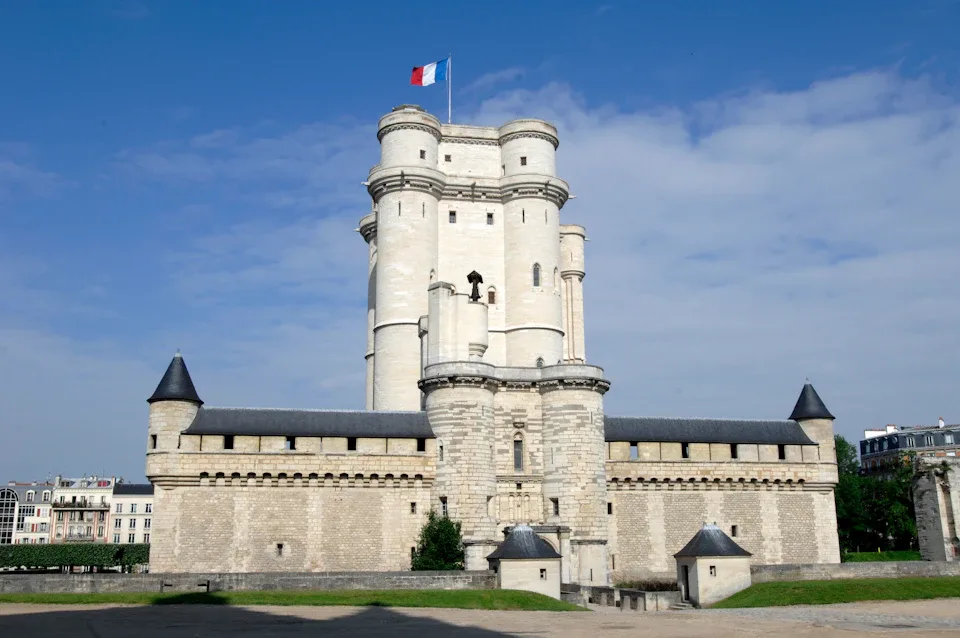
Prioritize Château de Vincennes if you value medieval history, military architecture, and quieter alternatives to central Paris attractions. Its massive keep, fortified ramparts, and Gothic Sainte-Chapelle offer a distinctive contrast to Versailles and Paris’s later palaces, with enough to see in a focused 1.5 to 2 hours.
Château de Vincennes
Why visit
Lower its priority if you want richly furnished interiors, grand decorative rooms, or a major art collection; much of the fortress is stark and relatively empty. It is also less essential on a short first visit to Paris, so treat it as a worthwhile half-day addition rather than a must-see: arrive before 12:00 or after 14:00 and use Metro Line 1.
What to know beforehand
Château de Vincennes is best for travelers who enjoy medieval fortifications, military history, and stark Gothic architecture more than furnished palace interiors.
The keep, ramparts, and Sainte-Chapelle provide impressive scale and historical depth, but the rooms are largely bare; visitors expecting Versailles-style decoration or extensive museum displays may leave underwhelmed.
🎫 Tickets, tours & discounts
Reduced-Rate Entry Ticket
- Self-guided keep admission
- Sainte-Chapelle access
- Fortified ramparts access
- Eligibility required for reduced rate
Standard Entry Ticket (Full-Price Admission)
- Self-guided keep admission
- Sainte-Chapelle access
- Fortified ramparts access
- Online entry-slot booking
Paris Museum Pass Entry
- Keep admission included
- Sainte-Chapelle access included
- Fortified ramparts access included
- Valid Paris Museum Pass required
Which ticket to choose
For most visitors, the standard admission ticket is enough. It covers the keep, the fortified enclosure, and the Sainte-Chapelle, with the Revelacio tablet included at no extra charge.
The tablet offers an English-language self-guided route and takes about 90 minutes, making it a better choice than paying for a separate guide if you prefer to explore independently.
There is no need to look for a VIP, fast-track, or luxury ticket at Château de Vincennes. Paying more makes sense only if you want a scheduled guided visit, access to the upper levels of the keep, or a specialist tour of the Sainte-Chapelle roof structure. These experiences are limited and generally French-speaking.
- Standard ticket: best for independent visits and first-time travelers.
- Revelacio tablet: included with admission; available in English, French, and Spanish.
- Guided visit: worthwhile for deeper historical context or limited-access areas.
- Paris Museum Pass: useful only if you are already visiting several included monuments.
The common first-visit mistake is buying a guided experience when the basic ticket already includes a substantial audio-visual tour. Choose the standard ticket unless the guide or restricted-access area is the main reason for visiting.
When to go
Arrive before noon for the calmest visit and the best chance to explore the keep without feeling rushed. If you arrive around midday, plan around the Sainte-Chapelle closure: it is closed every day from 1:00 pm to 2:00 pm, so either visit the chapel first or return to it after 2:00 pm.
The château is open from 10:00 am to 6:00 pm during the longer opening season and from 10:00 am to 5:00 pm during the shorter one. Last admission to the Sainte-Chapelle is 45 minutes before closing, while access to the keep ends 30 minutes before closing.
Solo travelers should choose the morning for a quieter, more flexible route. Families will benefit from arriving before noon and using the dedicated family tablet route. Photographers should come early for fewer people in the courtyards, or after 2:00 pm if the Sainte-Chapelle is the priority.
Combos and discounts
The Paris Museum Pass includes Château de Vincennes and is useful when the castle forms part of a wider museum itinerary. It is not a money-saving purchase for this monument alone, since the regular admission is modest; it starts to make sense when you are also visiting several major Paris museums and monuments during the same pass period.
There is no standard Château de Vincennes combo with Versailles, the Louvre, or another nearby attraction, and no separate off-peak ticket. Children under 18 enter free, as do EU nationals and eligible legal residents aged 18 to 25.
The monument also offers free admission to several qualifying visitors, including people with disabilities and their companion, jobseekers, and holders of an Education Pass.
Groups of 20 or more paying adults receive a reduced group rate, with advance booking required. The first Sunday of each month from November through March is free for everyone, making it the clearest saving for flexible travelers.
Important: Bring the required proof of age or eligibility for free admission. Large bags over 40 x 20 x 50 cm are not allowed, and there are no luggage lockers on site.
When it makes sense to take a tour
A guided tour adds the most value if you want the fortress explained as a political and military complex rather than simply admired as medieval architecture.
A guide can connect the keep, royal residence, prison history, Sainte-Chapelle, and defensive walls into one narrative, which is especially useful for visitors who do not already know French medieval history.
The regular guided visit is in French and lasts about 90 minutes. Special tours can reach the upper levels of the keep or the Sainte-Chapelle roof structure, but they are limited and require a separate reservation. English-speaking visitors can usually get more from the included Revelacio tablet than from joining a French-language tour.
Skip the guided option if you prefer to set your own pace, are mainly interested in architecture and photography, or have only 90 minutes. The self-guided visit is detailed enough for most independent travelers, while a tour is best treated as an upgrade for interpretation or restricted access rather than a requirement for seeing the main monument.
Crowd indicator
Expect moderate crowds, with peak attendance on weekends and during the afternoon after the chapel reopens.
Mini-calculator based on crowd levels by day and time.
This day is usually calmer than average. This slot has a higher chance of a comfortable visit: compromise between light and visitor flow. Weather is currently not ideal: mostly clear 🌤️.
Nearest days
How to find the entrance
Address: 1 Avenue de Paris, 94300 Vincennes
Nearest metro: Château de Vincennes, Metro Line 1. The station is at the eastern terminal of the line and is directly beside the château, so you do not need to route through a shopping mall or a separate transport hub. Follow signs for the château and continue to the monument entrance at 1 Avenue de Paris.
Allow a few extra minutes for the ticket queue and for walking through the castle grounds to the keep and Sainte-Chapelle. Visit before 12:00 or after 14:00 if you want to see the chapel, as it closes for a daily midday break.
Practical limits & what to bring
What to consider before your visit
Booking is required. Allow 1.5 to 2 hours for the keep, Sainte-Chapelle, and the fortified grounds. The interiors are largely empty and stone-built, so expect a historical monument focused on architecture and scale rather than furnished royal rooms.
All bags pass through a security check at the main entrance, which can add a short wait during busy periods. Sainte-Chapelle closes daily from 12:00 to 14:00, so arrive before 12:00 or after 14:00 if you want to see both buildings in one visit.
Admission costs €13. Visitors under 18 and EU residents under 26 enter free. The monument is a working medieval fortress, so expect uneven surfaces, stairs, and time spent standing; it is less comfortable for visitors who need completely step-free access.
What you can and cannot bring
- Suitcases and large bags exceeding 40 x 20 x 50 cm are not allowed inside.
- Bags are subject to security screening at the entrance.
- Small personal bags that remain within the size limit can be brought inside.
- If you use the interactive tablet guide, you must leave a physical ID card, such as a driving licence or national ID card, as a deposit.
- The available visitor information does not establish separate bans on food, drinks, professional cameras, tripods, selfie sticks, or drones.
Luggage storage and personal belongings
There are no lockers or cloakroom facilities at Château de Vincennes. Leave suitcases and oversized backpacks at your accommodation or in luggage storage elsewhere before travelling to the fortress; security staff will refuse entry to bags above 40 x 20 x 50 cm, and you cannot store them on site.
Bring only the essentials: a valid ticket, a small bag, and comfortable footwear for stairs and historic stone surfaces. A physical ID card is also necessary if you want to borrow the interactive tablet guide.
Location and what's nearby
What kind of neighborhood
- Vincennes is a polished, residential town with elegant streets, local shops, bakeries, and a calmer pace than central Paris.
- The château and Bois de Vincennes attract families, joggers, history-focused visitors, and Parisians seeking open space.
- It suits a half-day built around medieval history, woodland walks, market streets, and an unhurried lunch.
- The area feels lived-in rather than tourist-oriented, with most activity concentrated around Avenue de Paris and the town centre.
Nearby on foot (up to 15 minutes)
- Bois de Vincennes — Woodland paths and open lawns immediately beyond the medieval walls · 5 minutes
- Hôtel de Ville de Vincennes — Elegant civic buildings and a pleasant town-centre square · 8 minutes
- Rue du Midi — Local shopping street lined with bakeries and independent shops · 10 minutes
- Église Saint-Louis de Vincennes — Striking modern church with a distinctive brick interior · 12 minutes
- Parc Floral de Paris — Formal gardens, seasonal displays, and family-friendly open space · 15 minutes
15–30 minutes by transport
- Paris Zoological Park — A large zoo that extends the forest-and-family theme · 10 minutes by taxi
- Lac Daumesnil — Lakeside paths, rowing boats, and relaxed woodland scenery · 15 minutes by taxi
- Musée de l’Histoire de l’Immigration — A strong thematic pairing for French imperial history · 20 minutes by metro
- Marché d’Aligre — Lively food market and neighborhood browsing in eastern Paris · 25 minutes by metro
Where to eat nearby
- L’Ours — Michelin-listed modern French tasting menus · expensive · reservation required · 10 minutes on foot
- Absolu Vincennes — Refined dining directly opposite the château · above average · book ahead · 2 minutes on foot
- Le Château des Vignerons — French bistro cooking with an extensive wine focus · mid-range · book ahead · 7 minutes on foot
- Maezaly — Creative seasonal plates in a compact local dining room · above average · book ahead · 10 minutes on foot
A ready-made day route
Start with the Château de Vincennes, then walk through Bois de Vincennes before continuing towards Hôtel de Ville de Vincennes and Rue du Midi. Stop for lunch at Le Château des Vignerons, then finish with the gardens and seasonal atmosphere of Parc Floral de Paris.
ReferenceFacts
Read more
Verified numbers and scale
- Height: 50 metres; the keep is regarded as Europe’s tallest medieval keep.
- Walls: More than 3 metres thick at the keep, built for both defence and royal residence.
- Construction: The main keep was completed in 10 years, an exceptional pace for the 14th century.
- Outer enclosure: More than 1 kilometre long, enclosing an area comparable to a medieval town.
- Towers: Nine perimeter towers rise to roughly 40 metres and include rooms, fireplaces, and latrines.
- Garrison: Between 70 and 80 soldiers protected the castle during Charles V’s reign.
Myths and misconceptions
- Myth: Château de Vincennes was built primarily as a prison. In reality: It began as a royal residence and fortress; prison use started in the late 15th century.
- Myth: The Sainte-Chapelle was completed entirely in the Middle Ages. In reality: Founded in 1379, it was completed during the Renaissance by Philibert Delorme.
- Myth: The keep served only a military purpose. In reality: It contained royal apartments, a council chamber, a study, and manuscript storage.
- Myth: Château de Vincennes stands inside Paris proper. In reality: It is in the separate commune of Vincennes, immediately east of Paris.
Rare and unusual details
- Clock bell: A copy represents the 1369 bell installed on a civil building rather than a church.
- Internal layout: The keep has six floors, each arranged around a central hall and four corner turrets.
- Royal route: During the Middle Ages, Charles V walked along an uncovered rampart path from his study to his apartments.
- Stairway: The courtyard contains one of the oldest preserved outwork stairways, lit by five openings stacked vertically.
- Prison trace: One inmate carved “Domus Dolorum”, meaning “House of Sorrows”, into a keep wall.
- Chapel roof: The Sainte-Chapelle’s 15-metre-high timber framework retains much of its Renaissance construction.
BackgroundHistory
Read more
Château de Vincennes began as a royal stronghold built to defend the eastern approach to Paris and protect the monarchy. Its massive keep reflects a period when royal power was expressed through fortified walls, controlled access, and military scale rather than decorative palace interiors.
The château later served as a royal residence and a prison, giving it a more complex history than a simple defensive fortress. Today, the bare stone rooms, ramparts, and Gothic Sainte-Chapelle let visitors see how medieval authority, religion, and security were combined in one site—an especially strong contrast with the later grandeur of Versailles.
♿ Accessibility & families
Accessibility and family policy
- Wheelchair users and reduced-mobility visitors: Château de Vincennes is only partially accessible. Ramps provide step-free access to the ground floors of the Donjon and Sainte-Chapelle, plus the video and model rooms. The upper levels are not step-free: reaching the first and second floors of the Donjon involves about 150 uneven steps, while the Sainte-Chapelle gallery requires around 70 steps. An accessible Revelacio tablet recreates areas that cannot be reached. Disabled visitors and one companion receive free admission with valid proof.
- Strollers: Strollers are allowed in the courtyard but not inside the Donjon or Sainte-Chapelle; they can be left in the designated supervised area. A baby-changing table is available in the ticket-office toilets. Picnics are not permitted on the site, and the outdoor areas can be windy while the Sainte-Chapelle is unheated.
- Families with children: Admission is free for everyone under 18. Children under 16 must be accompanied by an adult. Expect stairs, uneven surfaces, narrow historic interiors and possible school-group crowds; benches and chairs provide rest points, and Wednesday visits and school holidays are generally calmer.
🏢 On-site amenities
On-Site Amenities
- Restrooms: Toilets are available inside the monument, in the keep courtyard and at the back of the ticket office and gift shop. They are accessible only to visitors with a monument admission ticket. A baby-changing table is available in the ticket office-shop toilets.
- Food and drinks: There is a dining area in the keep courtyard, but Château de Vincennes does not operate as a full-service premium restaurant. Eating and drinking are prohibited in the main visitor areas, and picnics are not allowed inside the fortress.
- Shop: The entrance area includes a bookshop and gift shop focused mainly on history, heritage, books, and monument-related souvenirs.
- Other facilities: No nursing room or prayer room is provided. No luggage storage is available, so large bags and suitcases cannot be left on-site.